
If you are new to Bob Seger, start with the songs that show his range fastest: "Night Moves," "Turn the Page," "Old Time Rock and Roll," "Against the Wind," and "Hollywood Nights." Those five Bob Seger classic rock songs give you the storytelling, road grit, bar-band energy, and grown-up reflection that made his catalog last.

Best Bob Seger songs for new listeners
The easiest mistake is starting with only the biggest radio hits and assuming you have heard the whole story. Seger makes more sense when you hear him in a few different modes: the nostalgic storyteller, the road-weary singer, the straight-ahead rocker, and the older voice looking back without turning soft.
For a first listen, use this order if you want a quick path: play "Night Moves" for the songwriting, "Turn the Page" for atmosphere, "Old Time Rock and Roll" for instant recognition, "Against the Wind" for perspective, and "Hollywood Nights" for speed. If one of those clicks, follow that lane deeper instead of forcing a full discography run right away.
Night Moves for nostalgic storytelling
"Night Moves" is usually the best first stop because it does not rely on volume or nostalgia alone. It starts as a memory of youth and desire, then quietly turns into a song about time passing. That turn is what separates it from a simple coming-of-age track.
Listen for how patiently Seger lets the song open up. The acoustic warmth, the vocal phrasing, and the shift from private memory to adult reflection make it a strong test: if this song works for you, the album Night Moves is probably the next place to go.
Turn the Page for road-worn atmosphere
"Turn the Page" is the Seger song to play when you want mood before momentum. The saxophone line sets a late-night highway feeling almost immediately, and the lyric avoids the usual fantasy version of touring. It is tired, watchful, and lonely in a way that still feels believable.
This is not only a musician's road song. It also lands if you have ever driven too long, worked away from home, or felt anonymous in a place where nobody knows you. For a quiet night drive, choose this over the louder hits.
Old Time Rock and Roll for instant energy
"Old Time Rock and Roll" is the obvious crowd-pleaser, and that is not a weakness. It is short on mystery but strong on function: piano, sax, rhythm, and a vocal that sounds like it wants the whole room involved. If you are building a starter playlist for friends who only know Seger casually, this is the safest early add.
- Best use: parties, casual playlists, classic rock radio energy.
- Do not judge him only by it: it shows his fun side, not his full writing depth.
Against the Wind for mature reflection
"Against the Wind" is where Seger's adult perspective becomes the main attraction. The song looks back at choices, fatigue, and endurance without sounding defeated. It is a good pick for listeners who prefer reflection over swagger.
The practical difference from "Night Moves" is age. "Night Moves" remembers youth as a vivid turning point; "Against the Wind" sounds like someone measuring the distance between who he was and who he became.
Hollywood Nights for fast-paced rock
"Hollywood Nights" brings the tempo up without losing the storytelling instinct. It feels bright, restless, and slightly dangerous, like a story moving too fast to slow down. Put it next to "Old Time Rock and Roll" and you hear two different kinds of energy: one rooted in early rock fun, the other built for late-70s arena momentum.
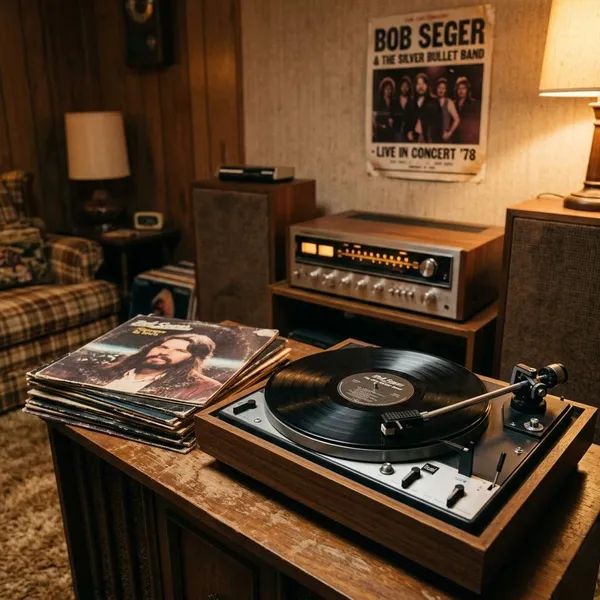
Bob Seger songs for every mood
Seger is easier to enjoy when you choose by mood instead of ranking everything from "best" to "least essential." A road trip, a late-night nostalgic listen, and a loud weekend playlist do not need the same songs.
Turn the Page and Hollywood Nights for road trips
For a long drive, "Hollywood Nights" works early, when the road still feels open and the volume can come up. "Turn the Page" fits later, when the trip gets quieter and the repetition starts to settle in. That pairing gives you both sides of travel: excitement first, distance after.
Night Moves and Mainstreet for nostalgia
"Night Moves" and "Mainstreet" both look backward, but they do it at different distances. "Night Moves" feels wide and cinematic; "Mainstreet" feels smaller, more local, and more attached to a specific place.
Choose "Night Moves" when you want the big emotional sweep. Choose "Mainstreet" when you want something quieter, closer, and less overplayed. Together they show why Seger's nostalgia usually feels lived-in rather than cheap.
Katmandu and Ramblin Gamblin Man for energy
When the reflective songs start to feel too polished, "Katmandu" and "Ramblin' Gamblin' Man" bring back the rougher edge. "Katmandu" has a loose bar-band push, while "Ramblin' Gamblin' Man" carries more of his early garage-rock urgency.
- Pick "Katmandu" for a rowdier live-band feel.
- Pick "Ramblin' Gamblin' Man" for the earlier, sharper Seger sound.
- Skip them first if you only want the polished late-70s radio version of his catalog.
Against the Wind and Like a Rock for reflection
These are the songs for a slower, more adult listen. "Against the Wind" is about endurance after years of motion; "Like a Rock" looks at youthful strength from a distance. Both can be easy to underrate if you only hear them as background classic rock.
"Like a Rock" also has the burden of being remembered by many people through advertising, but the song itself is more thoughtful than that association suggests. Give it a clean listen before dismissing it.
Why Live Bullet is essential
Live Bullet matters because it explains the part of Bob Seger that studio hits alone can miss. The album makes his songs feel physical, communal, and harder-edged, especially if your first contact with him was through radio staples.

It captures the band at full power
Live Bullet shows how much Seger depended on force and timing, not just songwriting. The Silver Bullet Band sounds tight without becoming sterile: guitars push, drums land hard, and the saxophone adds color without crowding the songs.
That makes the album a smart second step for new listeners. Start with the key studio tracks if you need the hooks, then use Live Bullet to understand why people talk about Seger as a live performer, not just a radio artist.
It gives early songs more energy
Some early Seger songs can feel more convincing live than in their original studio form. The audience, faster attack, and rougher vocal edges make the material feel less like a period piece and more like working rock music.
It turns road stories into crowd anthems
"Turn the Page" is the clearest example. On paper, it is a lonely road narrative; live, it becomes something shared without losing the loneliness. That is a difficult balance, and Seger's best performances find it naturally.
For someone listening alone on headphones, the studio version may feel more intimate. For someone trying to understand his concert reputation, the live version gives the better answer.
It connects the hits with deeper cuts
A good live album can act like a bridge, and Live Bullet does that especially well. It makes the deeper cuts easier to approach because they sit beside the better-known songs with the same urgency and purpose.
Conclusion
The best first route through Seger is not complicated: start with the five core songs, choose the mood that fits you, then move into Live Bullet if the performances are what grab you. If you want songwriting, go toward Night Moves; if you want stage power, go live; if you want familiar classic rock energy, keep "Old Time Rock and Roll" and "Hollywood Nights" close. That path gives you a real feel for why his music still works without turning the catalog into homework.