
If you are checking canada classic rock one-hit wonders, the first question should not be "which song do people still remember?" It should be "how many national Canadian Top 40 hits did the act actually have?" That one distinction clears up many disputed classic rock names, because radio memory and Canadian chart history often tell different stories.

The Canadian one hit wonder rule
A fair Canadian one-hit-wonder test needs a fixed rule before any band names enter the discussion. Otherwise, the label becomes a mix of oldies-radio familiarity, U.S. chart memory, and personal nostalgia.
One national Top 40 hit
The cleanest rule is this: an act qualifies only if it had one single reach the national Canadian Top 40, and no other single reached that same threshold. A song that was loved locally, played for decades later, or remembered by a small fan base does not count unless it made the national chart.
This matters most when a band has one song that towers over the rest of its catalogue. If the follow-up single peaked at No. 34, it may feel forgotten now, but it still breaks the one-hit-wonder label under a Top 40 rule.
Canadian charts over US charts
For a Canadian classification, Canadian charts should come first. An artist can be a one-hit wonder in the United States and still have several real hits at home, so using U.S. Billboard results as the main test can shrink a Canadian career unfairly.
One consistent chart source
Pick one national chart source for the correct period and stay with it. For most classic rock acts, that means RPM, because it covers the main years when these singles were released. Later acts may need the Canadian Singles Chart or the Billboard Canadian Hot 100 instead.
- 1964 to 2000: RPM is usually the key national source.
- 2001 to 2007: use the Canadian Singles Chart period.
- 2007 onward: use the Billboard Canadian Hot 100.
Every follow-up single counted
The signature song is only the starting point. Every credited follow-up single needs to be checked, because the second or third chart entry is often what decides the case.
This is where many "obvious" one-hit-wonder claims become less obvious. A band may be remembered by one anthem because that track survived on classic rock radio, while another single charted nationally at the time and then slipped out of public memory.
Why RPM matters for Canadian classic rock
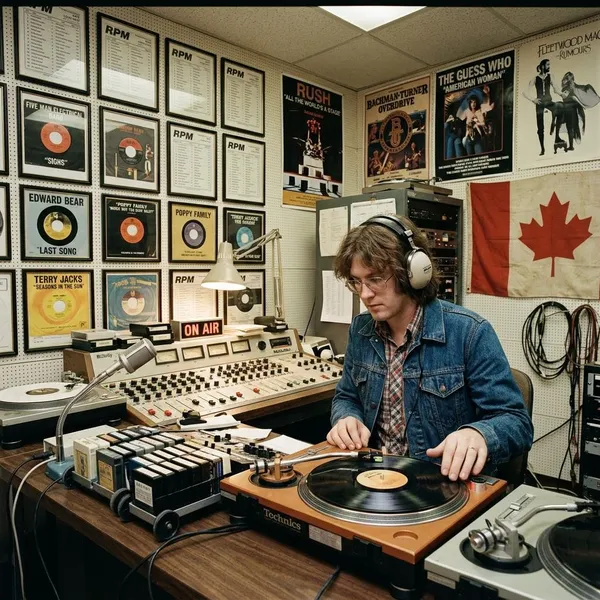
RPM matters because it gives Canadian classic rock its own chart record instead of forcing Canadian artists into an American story. For disputed acts, it is often the difference between a casual label and a defensible classification.
It covers the main classic rock years
RPM spans the years that matter for much of Canadian classic rock: the late 1960s, the 1970s, the 1980s, and into the 1990s. That makes it the natural place to check acts whose songs still turn up on oldies and classic rock stations.
For a listener, those decades can blur together. A station may play a 1969 hit beside a 1982 hit, making both feel like part of one timeless radio pile. RPM puts each single back into its release-era context.
It records national weekly charts
RPM's weekly listings let you check more than reputation. You can see whether a single entered the national chart, how high it climbed, and whether it crossed the Top 40 line.
For one-hit-wonder purposes, the peak is the key number. The weekly run can still help, though: a brief low-chart appearance is not the same as a broad national hit, and a Top 40 follow-up should not be dismissed just because it is rarely played now.
It reveals forgotten follow-up hits
The most useful RPM discoveries are often the songs nobody argues about anymore because nobody remembers them strongly. Motherlode is a good kind of case to check carefully: many listeners know "When I Die," but the follow-up chart record is what determines whether the one-hit label really fits.
Crowbar, Sweeney Todd, and the Payola$ are the same kind of warning sign. If you only know the best-known song, do not assume the chart story stops there. Look for every national entry before applying the label.
It separates charts from radio memory
Radio memory answers a different question from chart history. It tells you what programmers kept playing, what listeners kept requesting, or what later formats decided was durable. Chart history tells you what sold, aired, or performed nationally during the release period, depending on the chart method used at the time.
How to verify a Canadian one hit wonder
The safest method is to work like a chart checker, not like a playlist maker. Start with the artist's Canadian release period, then count every national Top 40 entry under the correct credit.
Choose the correct chart period
Match the single to the national Canadian chart that existed when it was released. Most classic rock cases belong in the RPM years, but a later Canadian act should not be forced into RPM just because the older source feels more familiar.
If an act crosses chart eras, check each single in its own period. That extra step is slower, but it avoids a common bad result: judging a 1970s single, a 1990s single, and a 2000s single as if they all lived in the same chart system.
Find every national chart entry
Do not stop once you find the famous song. Make a complete list of national chart entries, then mark which ones reached the Top 40.
- Write down the act name exactly as credited.
- List every Canadian national singles-chart entry you can find.
- Record each peak position.
- Count only the entries that reached the Top 40.
- Apply the label only if the count is one.
Check alternate band and artist credits
Classic rock can get messy because musicians move between bands, solo careers, renamed projects, and short-lived lineups. The practical rule is to follow the chart credit, not just the personnel.
Sweeney Todd is a useful example of why this matters. Songs credited to Sweeney Todd belong to the band's count; Nick Gilder solo hits belong to Nick Gilder's count. Same musician, different chart entity.
Separate chart peaks from airplay
Airplay can explain why a song feels bigger than its chart peak, but it should not replace the chart test. A track may be a weekend-radio staple for decades and still be only one part of the artist's original Canadian chart story.
Use this split when the situation is low-stakes versus high-stakes. For a party playlist, the remembered song is enough. For a blog post, database note, trivia answer, or music-history claim, check the chart peak before repeating the label.
Apply the same rule to every act
The rule only works if every act gets the same treatment. If one band is judged by Canadian Top 40 peaks, another by U.S. performance, and a third by what still plays on FM radio, the category becomes meaningless.

Conclusion
The most useful way to handle Canadian classic rock one-hit-wonder claims is to check the Canadian national Top 40 count before trusting the familiar story. If the act had only one qualifying hit, the label can be fair; if a forgotten follow-up also made the Top 40, the better description is usually "remembered for one song," not "one-hit wonder."