
If you are trying to get into canadian classic rock bands, start with the acts that give you the biggest range fastest: Rush for prog, The Band for roots rock, The Guess Who and Bachman-Turner Overdrive for early crossover hits, April Wine and Triumph for guitar-driven rock, and Loverboy for polished 1980s arena hooks. The best choice depends less on who is "greatest" and more on what kind of rock you actually want to hear first.

Essential Canadian classic rock bands
Canada's classic rock story is not one sound. Some bands became international reference points, while others became part of Canadian radio culture in a way that does not always show up on global rankings. If you only have time for a first pass, these names give you the clearest map.
Rush
Rush are the first stop if you want musicianship, ambition, and a catalog that rewards repeat listening. Geddy Lee, Alex Lifeson, and Neil Peart made progressive rock feel powerful rather than purely academic, moving from long-form pieces such as "2112" to tighter radio staples like "Tom Sawyer," "Limelight," and "The Spirit of Radio."
The Guess Who
The Guess Who matter because they were early proof that a Canadian rock band could cross into the U.S. mainstream without losing its own identity. "American Woman," "These Eyes," and "No Time" show how easily they could move between tough rock, melody, and soul-leaning vocals.
They are a strong pick if you like late-1960s and early-1970s rock that gets to the point quickly. Burton Cummings gives the songs personality, while Randy Bachman's guitar work keeps the band from feeling too polished or lightweight.
Bachman-Turner Overdrive
Bachman-Turner Overdrive, usually shortened to BTO, are the band to play when you want riffs, momentum, and choruses that sound built for car speakers. "Takin' Care of Business," "Let It Ride," and "You Ain't Seen Nothing Yet" are not complicated songs, but they are extremely effective ones.
Their appeal is practical: if you want Canadian classic rock for a road trip, a backyard playlist, or a no-fuss introduction for someone who does not care about prog complexity, BTO works almost immediately.
The Band
The Band sit slightly outside the usual hard-rock conversation, but they are essential. With several Canadian members and a sound rooted in folk, country, blues, gospel, and rock, they helped define roots rock without making it feel like a history lesson.
"The Weight," "Up on Cripple Creek," and "The Night They Drove Old Dixie Down" are built around feel, character, and ensemble playing rather than obvious showmanship. Choose The Band first if your taste leans toward storytelling, warm arrangements, and songs that age slowly instead of chasing instant impact.
April Wine
April Wine are one of the easiest bands to underestimate from outside Canada. They were consistent, melodic, and durable, with enough guitar weight for rock fans and enough polish for radio listeners.
- Start here: "I Like to Rock" for the punchier side.
- Then try: "Just Between You and Me" for the more melodic side.
- Best fit: listeners who want classic rock that is accessible without being soft.
Triumph
Triumph are a smart next step after Rush if you like the power-trio format but want something more arena-facing. "Lay It on the Line," "Magic Power," and "Fight the Good Fight" mix hard rock, melody, and a big-stage sense of drama.
They are especially good for listeners who want guitar-driven classic rock with lift. Rush often feels more intricate and cerebral; Triumph feels more direct, bright, and concert-ready.
Loverboy
Loverboy bring the 1980s into the Canadian classic rock picture. "Turn Me Loose," "Working for the Weekend," and "Lovin' Every Minute of It" are glossy, catchy, and built for quick payoff.
If you are making a party playlist, Loverboy will usually work faster than the more serious or rootsy bands. If you want depth and album-to-album evolution, they may not be your first stop, but for high-energy radio rock they earned their place.
Best songs and albums to start with
The easiest way to explore these bands is to pair one signature song with one album. A single track tells you whether the sound works for you; the album shows whether the band has more to offer than one famous chorus.
- Rush — "Tom Sawyer" and Moving Pictures: the best balance of technical playing, sharp production, and approachable songwriting.
- The Band — "The Weight" and Music from Big Pink: the right entry point for roots rock, group vocals, and earthy atmosphere.
- April Wine — "I Like to Rock" and The Nature of the Beast: a strong first listen for melodic hard rock with Canadian radio staying power.
- Triumph — "Lay It on the Line" and Allied Forces: ideal if you want arena-sized guitar rock with a polished but muscular sound.
- Loverboy — "Turn Me Loose" and Loverboy: the quickest route into bright, hook-heavy 1980s Canadian rock.
For a deeper weekend listen, play the recommended song first, then the album, then one live version. Many of these bands made more sense on stage, especially Rush and Triumph, where the musicianship and crowd energy change how the songs land.
Canadian classic rock bands by sound
Ranking these bands is less useful than matching them to the sound you want. Someone looking for road-trip rock may not need the same starting point as someone who wants progressive musicianship or rootsy songwriting.
Rush and Max Webster for progressive rock
Rush are the obvious anchor for Canadian progressive rock: precise, ambitious, and still catchy when the arrangements get complex. Max Webster make a good companion because they bring a quirkier, more off-center personality to the same broad lane.
If Rush feels too serious at first, Max Webster can make the progressive side of Canadian rock feel looser and stranger. If Max Webster feels too odd, Rush gives the style more structure and scale.
Triumph and Loverboy for arena rock
Triumph and Loverboy both belong in the arena-rock conversation, but they do different jobs. Triumph is the better fit for big guitar, dramatic choruses, and live-show energy; Loverboy is better when you want faster hooks and a cleaner 1980s radio sound.
| Listener mood | Better first choice |
|---|---|
| Big guitar and concert drama | Triumph |
| Catchy workplace or party rock | Loverboy |
| Melody with harder edges | Triumph first, then April Wine |
| Immediate 1980s energy | Loverboy |
The Band for roots rock
The Band are for listeners who care more about feel than volume. Their music is warm, layered, and full of character, with songs that often sound older than the era they came from.
Trooper and Prism for radio-ready rock
Trooper and Prism help explain why Canadian classic rock is deeper than the internationally famous names. They are not always the first bands mentioned outside Canada, but their songs fit the everyday radio side of the genre: upbeat, direct, and easy to remember.
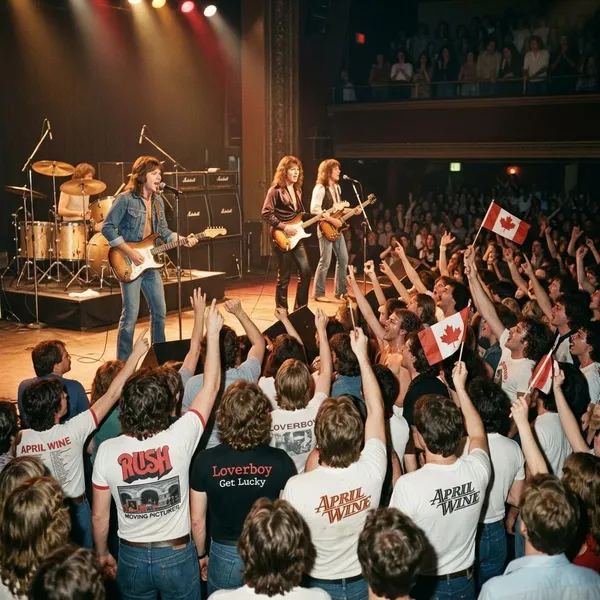
Why some Canadian bands were bigger at home
Some Canadian rock bands had global hits, while others became much more important inside Canada than abroad. That gap was not always about quality. Radio rules, touring routes, regional identity, and record-label support all shaped which bands crossed borders and which ones became home-country institutions.
Canadian radio gave local music stronger support
Canadian content rules helped domestic artists get heard more often on Canadian radio. That extra exposure mattered because classic rock loyalty is built through repetition: songs heard in cars, garages, arenas, bars, and family routines slowly become part of a shared memory.
This does not mean every supported band became great, but it did give strong local acts more room to grow. A listener in Canada could absorb bands like Trooper, Prism, or Chilliwack as regular radio presences, while someone elsewhere might never meet those songs unless they went looking.
National touring built loyal audiences
Canada's size made touring difficult, but it also made touring matter. Bands that kept returning to smaller cities, university towns, and regional venues could build loyalty that did not depend only on chart positions.
That is why a band can feel "major" to Canadian fans even if its international profile looks modest. If people saw the group live, heard the songs all summer, and watched the band come back year after year, the connection became personal rather than statistical.
Regional references connected with Canadian listeners
Place can change how a song feels. Canadian listeners often respond strongly to music that reflects long drives, cold weather, smaller cities, local characters, or a sense of distance that feels familiar even when the lyrics are not openly patriotic.
The Tragically Hip are the clearest later example of this effect, but the idea applies more broadly. A song does not need to announce itself as Canadian to feel local; sometimes the setting, mood, or phrasing does the work.
International distribution varied between bands
A band could be popular and still miss a larger international breakthrough if the timing, label support, promotion, or touring opportunities were not there. U.S. and overseas success often required more than good songs.

Conclusion
The best starting point is not one definitive ranking but a small listening path that matches your taste: Rush for ambition, The Band for roots and atmosphere, BTO or April Wine for sturdy rock-radio comfort, Triumph for arena guitar, and Loverboy for instant 1980s hooks. Once those names make sense, the deeper Canadian catalog becomes much easier to explore without feeling like a random list of old bands.