
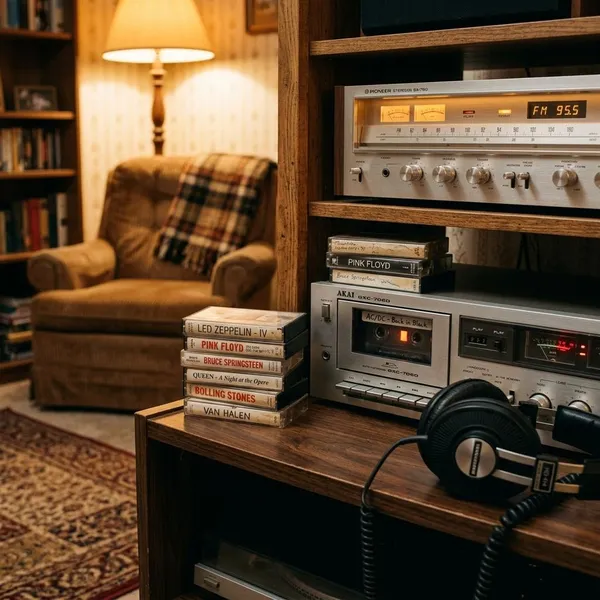
Cassette era classic rock is the rock sound most people reach for when they want big riffs, clean choruses, and songs that feel ready for a car stereo or a crowded room. It is mostly tied to the late 1970s through the 1980s, with some early 1990s overlap, but the real test is the feel: polished, hook-heavy, and instantly replayable.
What cassette-era classic rock sounds like
The fastest way to recognize cassette-era classic rock is to listen for impact. The song usually gives you something memorable early: a guitar riff, a vocal line, a drum hit, or a chorus that feels larger than the room it is playing in.
Big guitar riffs and polished production
A huge riff is often the first clue. Think of the way "Back in Black," "Panama," or "Sweet Child O' Mine" announces itself before the song has fully opened up. The riff is not just decoration; it is the hook that makes the track easy to identify from another room.
The production tends to be cleaner and more deliberate than rougher earlier rock. Guitars are layered, drums hit with more shine, and the vocal usually sits high enough in the mix that the chorus survives cheap speakers or a slightly worn cassette copy.
Arena-sized hooks and singalong choruses
The chorus is where many of these songs prove they belong. "Livin' on a Prayer," "We Will Rock You," "Any Way You Want It," and "I Love Rock 'N Roll" all work because a listener can join in quickly, even without knowing every verse.
- For a party or bar playlist: pick songs with choruses people can catch by the second repeat.
- For solo listening: choose deeper cuts only if the riff or vocal personality is strong enough to hold attention.
- For a mixed-age crowd: familiar hooks matter more than rare tracks.
A radio-ready mix of hard rock and pop
Cassette-era classic rock often sits between hard rock and pop. It keeps the guitars, volume, and attitude, but it borrows pop's sense of structure: clean verses, repeated hooks, and a chorus that arrives before the song loses casual listeners.
That is why artists like Def Leppard, Bon Jovi, Journey, Foreigner, Bryan Adams, and Billy Idol could cross over so widely. The songs had enough edge to feel like rock, but enough melody to work in cars, school gyms, diners, bedrooms, and family living rooms.
How cassette culture shaped classic rock
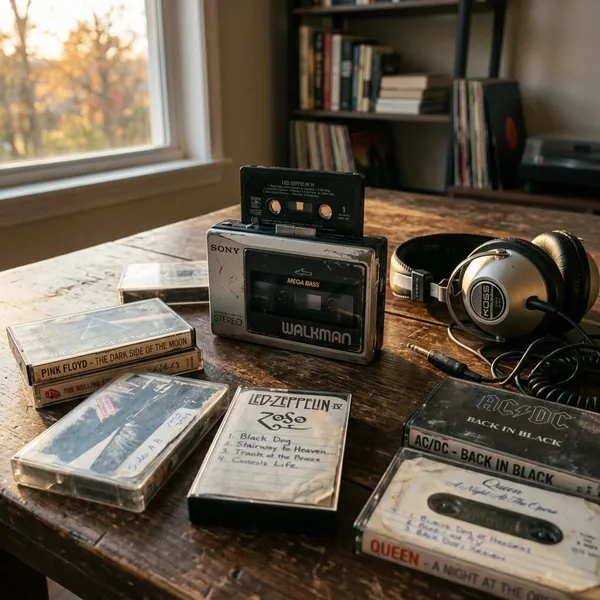
Cassettes changed the job rock songs had to do. A song no longer needed to live only as part of an album side or a radio broadcast; it could be taped, carried, replayed, rewound, and dropped into someone's daily routine.
That favored songs with a quick payoff. If a track sounded good on a home stereo, still held up on a Walkman, and cut through road noise in a car, it had a better chance of becoming part of someone's permanent rotation.
Mixtapes made listening personal
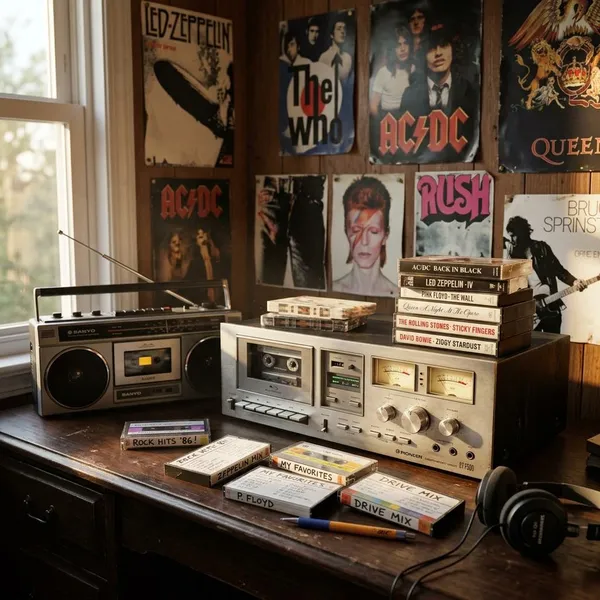
Mixtapes turned listeners into editors. Someone could build a tape for a crush, a road trip, a workout, a summer job, or a Friday night with friends, and cassette-era rock fit those purposes unusually well because so many songs were direct and emotionally clear.
Walkmans made rock portable
The Walkman made rock private as well as social. A song like "Crazy Train" or "Jump" could become part of a commute, a walk home, a study break, or a moment when someone needed a shot of confidence.
That portable setting rewarded clarity. Dense, subtle, slow-building tracks could be great, but cassette-era favorites often worked because they did not need perfect conditions. Even through basic headphones, the hook still landed.
Car stereos turned songs into road anthems
Cars may be the most natural setting for this music. The best road songs have a steady pulse, a bold opening, and enough brightness to cut through engine noise and conversation.
- Short drive: start with an instant-recognition track rather than a long album cut.
- Long road trip: mix anthems with mid-tempo songs so the playlist does not feel like one long chorus.
- Shared car: choose songs with broad hooks before heavier or more niche tracks.
That is why even songs without highway lyrics can feel like driving music. They create motion. The car gives the song scenery, and the song gives the drive a little more drama than it deserves.
How cassette-era rock differs from other rock periods
The easiest mistake is to define cassette-era rock only by release date. Date matters, but sound matters more. A song fits the era best when it has mainstream rock energy, polished presentation, and a hook strong enough to survive casual listening.
More polished than 1970s album rock
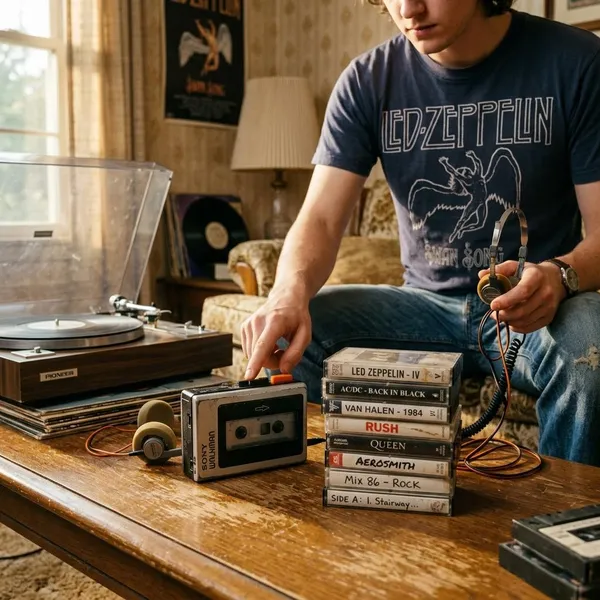
Many 1970s rock records feel looser, warmer, or more album-centered. Cassette-era classic rock often sounds tighter and more sculpted, with sharper drums, clearer vocals, and arrangements that move quickly toward the hook.
That does not make it better by default. If you want a long-form album experience, 1970s rock may feel richer. If you want a song that works immediately in a car, at a cookout, or while getting ready to go out, the cassette-era approach usually has the advantage.
More radio-driven than punk and alternative rock
Punk and alternative rock often value rawness, tension, speed, irony, or outsider identity. Cassette-era classic rock usually aims for wider access. It wants the riff to be obvious, the chorus to be useful, and the song to make sense on first contact.
A practical boundary helps here: if the track sounds like it is trying to challenge the room before it wins the room over, it probably leans punk or alternative. If it sounds like it wants everyone singing before the last chorus, it is much closer to cassette-era classic rock.
Brighter and more anthemic than grunge
Grunge changed the emotional temperature. Where cassette-era rock often pushes outward with confidence and spectacle, grunge more often turns inward toward discomfort, heaviness, or doubt.
| Listening situation | Cassette-era classic rock usually fits when... | Grunge usually fits when... |
|---|---|---|
| Party or crowd | You want lift, recognition, and singalong energy. | You want a heavier or moodier edge. |
| Road trip | You want forward motion and big choruses. | You want a darker, more reflective stretch. |
| Personal listening | You want confidence, release, or nostalgia. | You want tension, grit, or emotional weight. |
Why cassette-era classic rock still connects
Cassette-era classic rock still works because it is useful music. It fills space quickly, gives people something to recognize, and rarely asks for a perfect listening environment before it starts paying off.
That usefulness matters more than nostalgia alone. Older listeners may hear first cars, school dances, bedrooms, and summer nights in these songs, but younger listeners often come in through movies, sports arenas, family playlists, or streaming recommendations and still understand the appeal almost immediately.
Familiar hooks that work instantly
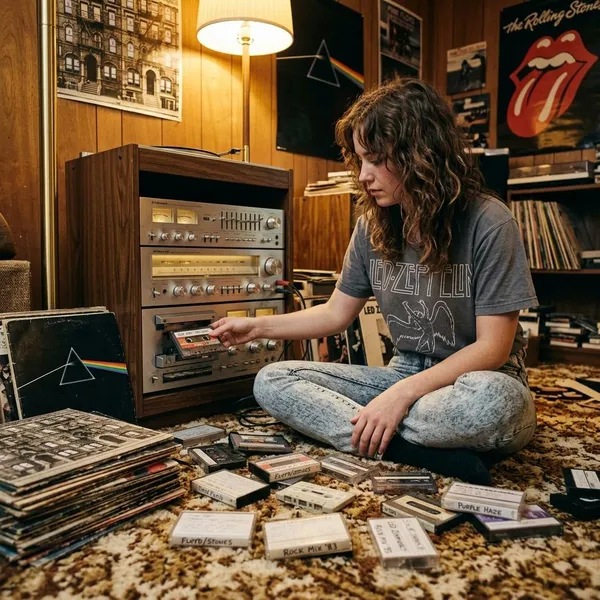
The strongest songs do not hide their best idea. A riff, chant, chorus, or vocal lift appears early enough that the listener has a reason to stay.
Songs made for cars, parties, and crowds
This is where the style has a real advantage over more delicate rock. It can be background music for a barbecue, the main event in a car, or the one song everyone recognizes at a wedding reception.
- Cars: choose bold intros and steady tempos.
- Parties: favor choruses over long instrumental stretches.
- Workouts or chores: lean into punchy drums and forward motion.
- Mixed company: start with familiar names before adding deeper cuts.
Nostalgia that crosses generations
The nostalgia works because it keeps renewing itself. A parent's old tape becomes a child's playlist discovery; a song from a teenage bedroom turns into a stadium chant; a road-trip favorite becomes a movie cue someone hears decades later.
That cross-generational pull is not automatic for every old genre. Cassette-era classic rock survives because the songs are still easy to use. They do not need a museum frame around them; they still sound good when someone turns them up.
Conclusion
Cassette-era classic rock is best understood as a feel as much as a date range: big riffs, bright production, quick hooks, and songs that make everyday settings feel bigger. If a track sounds right in a car, holds up on repeat, and can pull in people who do not all love the same kind of rock, it probably carries the cassette-era spirit.