
If you are trying to understand classic country rock bands, start with the groups that made country feel natural inside a rock setting: The Byrds, The Flying Burrito Brothers, Poco, Eagles, New Riders of the Purple Sage, and Pure Prairie League. From there, the fun is hearing how each band leaned differently—some toward pedal steel and storytelling, some toward harmonies and radio hooks, and some toward loose, road-tested jams.
What defines classic country rock
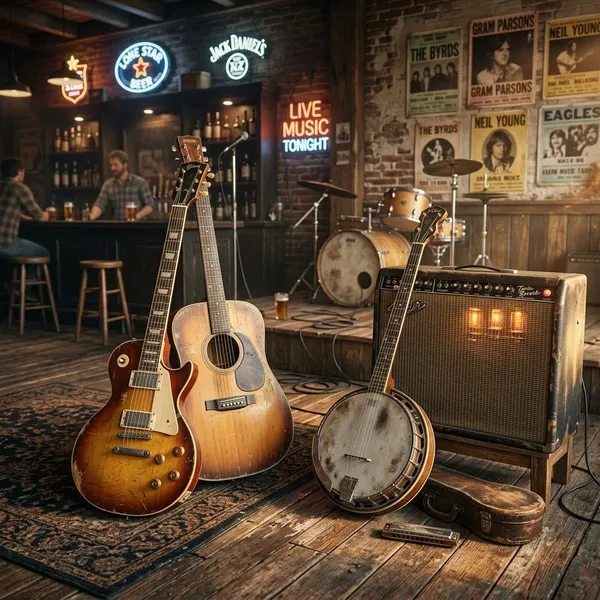
Classic country rock is not just rock music with a little twang added on top. The best version of the style keeps country's plainspoken writing and rootsy instruments, then gives them the movement, volume, and album-minded feel of rock. That is why the genre can work for someone who loves country storytelling and for someone who normally comes from folk rock, southern rock, or soft rock.
A useful way to hear the difference is to ask three quick questions:
- Does it use country color? Listen for pedal steel, fiddle, banjo, acoustic strumming, or a country-style vocal bend.
- Does it move like a rock band? The drums, bass, and electric guitars usually feel firmer than traditional country.
- Does the song still matter? Strong country rock usually has a lyric or melody you remember after the arrangement fades.
Country instruments with rock rhythms
Pedal steel, dobro, fiddle, banjo, and acoustic guitar are often the first clues, but rhythm is what turns the sound into country rock. A song may carry a country texture while the drummer pushes it with a rock backbeat, making it feel less like a dancehall shuffle and more like a band built for clubs, festivals, and FM radio.
If you usually avoid country because it feels too traditional, this is the doorway to try. The rock rhythm keeps the music moving, while the country instruments add warmth instead of making the song feel old-fashioned.
Folk harmonies and melodic hooks
Many classic country rock bands came through folk rock, so vocal harmony became one of the genre's strongest tools. Poco, Eagles, and Pure Prairie League all used stacked voices to make reflective songs feel open and inviting rather than heavy.
The hook matters too. Country rock can be sad, restless, or worn-in, but it rarely works when the melody is dull. A good test is simple: if the chorus still sits in your head after one listen, the band probably understood the genre's sweet spot.
Country storytelling with a rock edge
The lyrics often circle familiar country subjects—leaving home, bad timing, regret, freedom, distance, and love that does not quite hold. The rock edge changes the delivery. Instead of sounding purely traditional, the songs can feel sharper, louder, or more restless.
This is also where country rock differs from southern rock. The two can overlap, but country rock usually puts more weight on melody, harmony, and songcraft, while southern rock more often leans into blues-based guitar power and a heavier band attack.
Classic country rock bands that defined the genre
The core bands are best heard as a sequence, not as a ranked list. The Byrds opened a major door, The Flying Burrito Brothers made the country side feel deeper, Poco refined the harmony sound, Eagles brought it to a massive audience, New Riders of the Purple Sage stretched it toward a looser live feel, and Pure Prairie League showed how smooth the style could become without losing its roots.
If you only have time for a short listening path, use this order:
- Start with Eagles or Pure Prairie League if you want the most accessible entry point.
- Go to The Byrds when you want to hear where the shift became historically important.
- Try The Flying Burrito Brothers when you are ready for something rougher and more emotionally country.
- Add Poco and New Riders to hear the two main side roads: polished harmony and loose jam-friendly country rock.
The Byrds set the early blueprint
The Byrds are essential because Sweetheart of the Rodeo made the country-rock blend feel serious rather than decorative. Released in 1968, the album brought pedal steel, country phrasing, and roots-minded song choices into a rock context at a moment when that move still felt bold.
The record did not appear from nowhere, and it did not single-handedly invent the genre. Its real importance is that it gave other rock musicians permission to treat country music as a living source instead of a novelty. For listeners who like historical turning points, this is the place to start.
The Flying Burrito Brothers deepened the country sound
The Flying Burrito Brothers took the idea further, especially through Gram Parsons' vision of country feeling inside a rock-era band. The Gilded Palace of Sin sounds more committed to the country side than The Byrds' experiment, but it still carries a late-1960s looseness and attitude.
Choose this band when polished country rock feels too clean. The vocals can sound fragile, the pedal steel cuts deeper, and the writing has a bruised quality that makes the music feel personal rather than merely stylish.
Poco refined the harmony-rich style
Poco showed how graceful country rock could be when the band chemistry was the main attraction. Their music is bright, melodic, and carefully played, with harmonies that often feel more like a shared band language than a studio trick.
They are a smart pick for listeners who enjoy albums more than isolated hits. Poco may not have the same broad name recognition as Eagles, but they help explain where the softer, harmony-rich side of the genre came from.
Eagles took country rock mainstream
Eagles belong in country rock, especially in their early years. Their debut, Desperado, and parts of On the Border use country imagery, acoustic textures, western moods, and clean harmony writing, even though the band later moved further into mainstream rock.
Their role is different from The Byrds or The Flying Burrito Brothers. Eagles made the style unavoidable on radio. If you are building a beginner playlist for someone who says they "do not know country rock," Eagles are often the least intimidating first step.
New Riders of the Purple Sage added a jam-band feel
New Riders of the Purple Sage are the band to try when you want country rock to breathe. Their early connection to the Grateful Dead world matters because their music often feels relaxed, communal, and built for live performance rather than tight radio polish.
Pure Prairie League brought smooth crossover appeal
Pure Prairie League made country rock feel easy to enter. "Amie" is the obvious doorway, but the broader appeal is their balance of soft rock smoothness, country warmth, and friendly vocal arrangements.
That smoothness can be useful. If you are introducing the genre to someone who prefers melodic, low-friction listening over rougher late-1960s records, Pure Prairie League may work better than starting with the pioneers.
Overlooked classic country rock bands worth hearing
Once the main names make sense, the overlooked bands are where the genre becomes more interesting. They show that country rock was not one fixed sound: it could be bluegrass-leaning, southern and understated, rowdy, polished, or rugged. The mistake is treating the famous acts as the whole story.
Use your taste as the filter:
- Want rootsier songwriting? Try Dillard & Clark.
- Prefer gentle southern warmth? Go to Cowboy.
- Need something rowdy? Commander Cody is the better bet.
- Like polished 1970s harmonies? Souther-Hillman-Furay Band fits.
- Want a rougher edge? Mason Proffit is worth hearing.
Dillard & Clark
Dillard & Clark paired Gene Clark's emotional songwriting with Doug Dillard's bluegrass background, which gives their records a rootsy depth that sits slightly apart from the smoother country rock lane. They are ideal if you want to hear the bridge between folk rock, bluegrass, and early country rock.
Cowboy
Cowboy's appeal is quiet. The Jacksonville band leaned into warm arrangements, thoughtful songs, and a relaxed southern feel without turning into a heavier southern rock act.
They are a good choice for late-night listening or for anyone who likes country rock when it feels unforced. Nothing about the band screams for attention, but that restraint is exactly why their records can age so well.
Commander Cody and His Lost Planet Airmen
Commander Cody and His Lost Planet Airmen bring the barroom door crashing open. Their music pulls from western swing, rockabilly, honky-tonk, and good-time rock, making them one of the liveliest acts connected to the country rock conversation.
"Hot Rod Lincoln" is the easy entry point, but the bigger lesson is that country rock was not always soft, sad, or harmony-polished. Sometimes it was funny, loud, fast, and made for a crowded room.
Souther-Hillman-Furay Band
Souther-Hillman-Furay Band had the pedigree: J.D. Souther, Chris Hillman, and Richie Furay all brought serious country rock credentials. The music is polished and melodic, with the kind of harmony work that sits comfortably beside the smoother 1970s side of the genre.
The group can feel like a "what if" story because the talent was obvious, but the cultural footprint stayed smaller than expected. For listeners who already like Eagles, Poco, or soft country rock, this is an easy next discovery.
Mason Proffit
Mason Proffit offered a tougher and more rustic version of the style, mixing country, folk, and rock with a less polished edge. If the smoother bands feel too tidy, Mason Proffit can make the genre sound earthier and more urgent.
They are especially useful as a second-stage discovery: not necessarily where every beginner should start, but a strong choice once you want country rock with more grit.
Why classic country rock still matters
Classic country rock still matters because it solved a musical problem that has not gone away: many listeners like country storytelling but want rock energy, while others like rock bands but want warmer songs and more human-scale writing. The genre gives both groups a meeting place.
It also gives modern roots music a clear family line. Much of what now gets called Americana, alt-country, or roots rock still borrows the same tools: close harmonies, open-road imagery, pedal steel beside electric guitar, and lyrics that sound direct without feeling shallow.
The harmonies still sound fresh
Harmony is the reason many of these records still feel alive. When the voices blend naturally, the songs sound less like products of a decade and more like people singing in the same room.
That matters for modern listeners. If a lot of current production feels too polished or too processed, the more human vocal blend in bands like Poco, Eagles, and Pure Prairie League can feel surprisingly fresh.
The songs connect country and rock listeners
Country rock is useful because it lowers the barrier on both sides. A rock listener can hear steel guitar and country phrasing without feeling dropped into a completely unfamiliar world. A country listener can hear bigger drums, electric guitars, and album-oriented arrangements without losing the song's emotional center.
For a mixed playlist—say, a road trip where one person likes classic rock and another prefers country—this genre is often the compromise that does not feel like a compromise.
The sound shaped modern roots rock and Americana
Modern Americana is broader than country rock, but the debt is easy to hear. Bands and singer-songwriters still use the same in-between language: traditional instruments without strict traditionalism, rock arrangements without abandoning roots, and lyrics that value clarity over cleverness.
If Americana feels too wide as a label, older country rock gives you a cleaner starting point. Hear The Byrds and The Flying Burrito Brothers for the foundation, then move to Poco, New Riders, and Pure Prairie League to understand how flexible the sound became.
Conclusion
The best way into classic country rock is to treat it as a listening trail rather than a museum shelf: start with the accessible names, follow the sound that grabs you, and do not skip the smaller bands once the basics click. Eagles may open the door, but The Byrds, The Flying Burrito Brothers, Poco, New Riders, Pure Prairie League, and the overlooked acts around them show why the genre still feels warm, flexible, and worth returning to.