
The best classic rock album cover locations to visit are the ones where the real place still adds something to the record sleeve: Abbey Road for the instant photo, Heddon Street for Bowie history, St Mark's Place for a nearly intact facade, and Giant's Causeway for scenery that feels bigger than the album connection. Check first whether you are visiting an exact photo spot, a changed exterior, or a cover that was edited from several images, because that difference decides whether the trip feels satisfying or disappointing.
Iconic classic rock album cover locations
Some famous covers are easy to match on the ground. Others are worth visiting because the building, street, or landscape still carries the mood of the artwork, even if the exact sleeve cannot be recreated. The practical rule is simple: go to Abbey Road or St Mark's Place for a close visual match, Heddon Street or Battersea for changed-but-meaningful history, and Giant's Causeway when you want the place itself to be the main event.
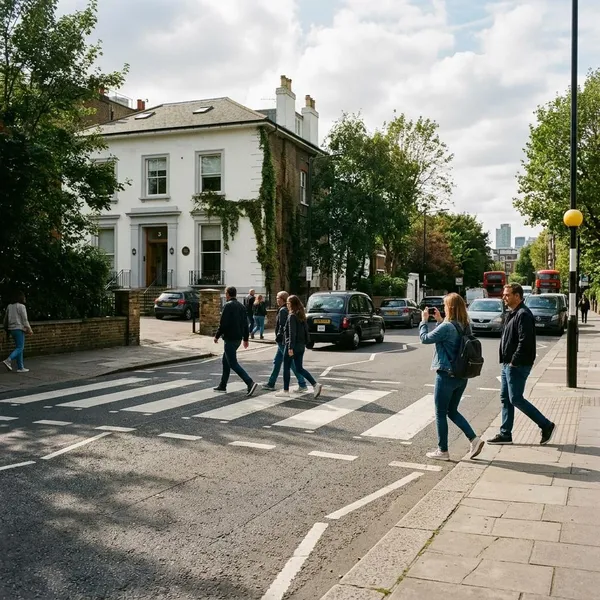
Abbey Road in London
Abbey Road is the most straightforward stop: the Beatles cover was photographed at the zebra crossing near Abbey Road Studios at 3 Abbey Road, St John's Wood. It is still a working road, not a staged attraction, which is exactly why the place feels oddly powerful when you arrive.
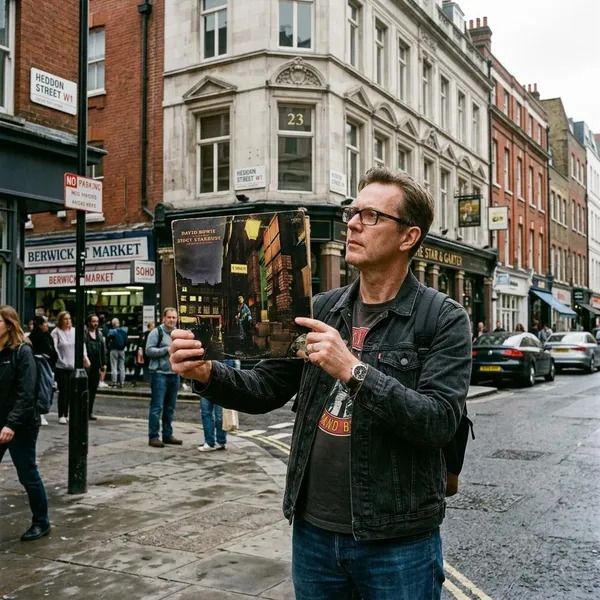
Heddon Street in London
David Bowie's The Rise and Fall of Ziggy Stardust and the Spiders from Mars was shot at 23 Heddon Street, just off Regent Street. The street is now cleaner, busier, and more commercial than the moody 1972 cover suggests, and the sleeve's color treatment makes the original atmosphere look more dramatic than the real street does today.
It works best as a short central London stop rather than a destination that needs half a day. If you are building a Bowie or West End walk, it is easy to include; if you expect the old "K. West" world to appear unchanged, you may find the visit too polished.
Battersea Power Station in London
Battersea Power Station is still visually tied to Pink Floyd's Animals, but it is not a perfect recreation spot. The famous inflatable pig and the final cover image involved staging and assembly, so the building is the real anchor, not the complete scene.
The setting has changed sharply. What once read as industrial and bleak is now surrounded by redevelopment, shops, restaurants, and riverside foot traffic. That makes it convenient, but the mood is different. Visit for the scale of the brick building and the four chimneys, not for the feeling that you have stepped into the sleeve unchanged.
96 and 98 St Mark's Place in New York
The Physical Graffiti buildings at 96 and 98 St Mark's Place are among the most satisfying album-cover stops in New York because the upper facade still reads clearly. The ground-floor businesses have changed, but the window rhythm and narrow East Village architecture remain easy to compare with the Led Zeppelin sleeve.
- Best for: fans who enjoy matching real buildings to cover art.
- Check first: the two adjoining addresses, not just "St Mark's Place."
- Expectation: strong facade match, different street-level details.
Sullivan Street and West 3rd Street in New York
Neil Young's After the Gold Rush is linked to the northwest corner of Sullivan Street and West 3rd Street in Greenwich Village. The location is not a dramatic landmark, and that is part of the charm: it shows how an ordinary corner can become memorable through timing, framing, and photographic treatment.
This stop is better for slow walkers than checklist travelers. Pair it with nearby Greenwich Village music-history streets, including Jones Street if you also care about Bob Dylan's The Freewheelin' Bob Dylan. The value is less about one perfect angle and more about seeing the neighborhood texture that made the image possible.
Giant's Causeway in Northern Ireland
Giant's Causeway provided the otherworldly landscape associated with Led Zeppelin's Houses of the Holy. The final artwork was constructed from multiple images, so the exact cover scene is not waiting in one fixed spot, but the basalt columns still explain why the location was chosen.
Treat this as a proper scenic outing, not a quick album-cover detour. Weather, light, footwear, and walking conditions matter more here than they do on a city sidewalk. If you are traveling with someone who is only mildly interested in rock history, this is the stop most likely to win them over anyway because the landscape stands on its own.
Best destinations for an album cover trip
The right destination depends on what kind of trip you want. A first-time visitor who wants several recognizable stops in one city should choose London. Someone who likes street photography and compact neighborhood walks may prefer New York. Los Angeles is better as part of a wider rock-history trip, while Northern Ireland suits travelers who want one unforgettable landscape rather than a dense list of addresses.
| Destination | Best fit | Main caution |
|---|---|---|
| London | Several famous locations in one trip | Some sites are spread out, so plan transport |
| New York | Street corners, facades, and walking routes | The payoff is subtle if you do not compare images |
| Los Angeles | Broader rock mythology and backstory | Some sites are altered, private, or underwhelming |
| Northern Ireland | Scenery with a strong album connection | It is a destination outing, not a quick stop |
How to verify an album cover location
Album-cover locations are easy to misidentify because old articles repeat vague claims, streets change, and some sleeves were edited heavily before release. Before building a route around any address, verify three things in this order: the exact spot, whether the current view still matches, and whether the published artwork was altered.
- Pin the exact place: use a street number, intersection, studio address, or named landmark.
- Compare visual evidence: match windows, rooflines, brickwork, corners, and building proportions.
- Check the artwork process: look for color treatment, staging, cropping, or composite work.
- Confirm access: decide whether it is a public road, private exterior, commercial area, or outdoor site with weather concerns.
- Use better sources: prioritize photographer interviews, liner notes, official sites, archives, and well-sourced music-history writing.
Confirm the exact address
Start with the address, not the legend. "St Mark's Place" is useful, but 96 and 98 St Mark's Place is what gets you to the Physical Graffiti facade. "Heddon Street" points you close, but 23 Heddon Street is the detail that prevents wandering around the wrong corner.
This matters most in cities where storefronts change faster than buildings. If signs, restaurants, or paint colors have changed, the number or intersection becomes your stable reference point.
Compare old and current photos
Use current street imagery and older photos before you go. Focus on features that are hard to change: window spacing, cornices, rooflines, brick patterns, doorway positions, and the relationship between neighboring buildings.
Check for edited or composite artwork
Do not assume the sleeve is a single untouched photograph. Animals and Houses of the Holy are both connected to real places, but the finished images involve artistic construction. The location is genuine; the exact printed scene may not be physically repeatable.
- Close recreation possible: Abbey Road, with patience and traffic awareness.
- Partial match: Heddon Street, because the street and mood have changed.
- Source-location visit: Battersea and Giant's Causeway, where the place matters more than exact duplication.
Review access before visiting
A famous location is not automatically a comfortable photo spot. Abbey Road is public but busy with traffic. Heddon Street is easy to reach but shared with restaurants and pedestrians. Private exteriors, hotel sites, and working city blocks should be treated as quick, respectful visits from the sidewalk.
For outdoor landscapes, check practical conditions instead of only checking the address. At Giant's Causeway, weather, tide-related conditions nearby, path closures, footwear, and daylight can affect the visit more than the album connection itself.
Use official and archival sources
When sources disagree, trust evidence over repetition. Stronger references include album credits, photographer or designer interviews, official studio or tourism pages, archive photos, and music-history publications that explain where their information came from.
Fan research can also be useful when it shows visual proof rather than just repeating a claim. The warning sign is an article that gives only a neighborhood name, no date, no photographer, and no matching details.
Conclusion
The most rewarding album-cover stops are not always the ones that look perfectly frozen in time. Abbey Road and St Mark's Place deliver the clearest visual payoff, London is the easiest all-round base, and Giant's Causeway is the strongest choice when you want the setting to feel memorable beyond the sleeve. Verify the address and the artwork history before you go, then visit with realistic expectations; that is what turns a quick photo stop into a trip that actually feels connected to the music.