
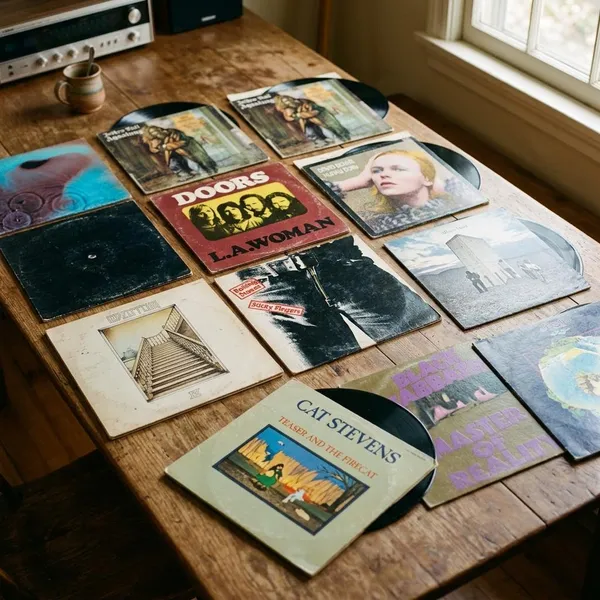
If you want the shortest answer, start with Led Zeppelin IV, Who's Next, or Sticky Fingers. Those records give you the clearest feel for why classic rock albums 1971 lists are so stacked, but the year is bigger than hard rock alone: it also gave us landmark singer-songwriter, prog, metal, glam, and live albums that still hold up outside their historical reputation.
Best classic rock albums of 1971
The most essential 1971 rock albums are not just famous names to check off a list. Each one shows a different version of what rock was becoming: heavier, more album-focused, more personal, and more comfortable stretching beyond three-minute singles.
Led Zeppelin IV — Led Zeppelin
Led Zeppelin IV is the safest first pick because it gives you almost everything people associate with early-70s rock in one place: huge riffs, acoustic contrast, blues weight, mystery, and songs that still feel unavoidable. "Black Dog," "Rock and Roll," "Stairway to Heaven," and "When the Levee Breaks" could each carry a lesser album.
Who's Next — The Who
Who's Next is the album to choose when you want force without looseness. "Baba O'Riley," "Behind Blue Eyes," and "Won't Get Fooled Again" are massive, but the record's real appeal is how tightly everything lands: the synth patterns drive the songs, Keith Moon sounds explosive, and the band never lets the scale turn bloated.
Sticky Fingers — The Rolling Stones
Sticky Fingers is 1971 blues rock with swagger, wear, and atmosphere. "Brown Sugar," "Wild Horses," and "Can't You Hear Me Knocking" show three different sides of the Stones: sharp, vulnerable, and locked into a groove. If Zeppelin is the grand doorway into the year, this is the record for listeners who care most about feel.
At Fillmore East — The Allman Brothers Band
At Fillmore East is the key live album of 1971 because it does not feel like a souvenir from a concert. It feels like the best version of the band's identity, especially in the guitar conversation between Duane Allman and Dickey Betts.
It is also a useful test of your taste. If extended live playing usually loses you, start with the shorter studio classics first. If you enjoy hearing a band build tension in real time, "Whipping Post" and "In Memory of Elizabeth Reed" explain the album's reputation quickly.
Master of Reality — Black Sabbath
Master of Reality is where 1971 turns darker and heavier. The riffs on "Sweet Leaf," "Children of the Grave," and "Into the Void" are simple enough to hit immediately, but the tone and pacing point toward doom metal, stoner rock, and heavier branches of hard rock that followed. It is not the most varied album here, but that focus is exactly why it works.
More great 1971 rock albums worth hearing
Once the biggest guitar records are covered, 1971 becomes more interesting rather than less. The next layer is where singer-songwriters, glam, rootsy rock, and piano-led albums make the year feel unusually deep.
Tapestry — Carole King
Tapestry belongs in the same conversation as the loud classics because it changed the emotional center of mainstream album listening. "It's Too Late," "I Feel the Earth Move," and "So Far Away" are direct without sounding plain, and the arrangements leave enough space for the songs to breathe.
Imagine — John Lennon
Imagine is more than its title track. The album moves from idealism to bitterness to vulnerability, with "Jealous Guy" and "Gimme Some Truth" showing how quickly Lennon could shift tone. It is a strong pick for listeners who want songwriting with some friction rather than pure comfort.
Every Picture Tells a Story — Rod Stewart
Every Picture Tells a Story feels loose in the best way: folk, roots rock, and ragged rock-and-roll energy all sitting around the same table. "Maggie May" is the famous doorway, but the full album works because Stewart's voice makes the songs feel lived in rather than performed from a distance.
Ram — Paul and Linda McCartney
Ram is the 1971 album to try when you want charm, odd turns, and melodic abundance instead of heaviness. Its reputation has grown because the homemade feel now sounds like personality, not a flaw. For vinyl buyers, it is also the kind of record that rewards repeat plays more than a quick singles scan.
Madman Across the Water — Elton John
Madman Across the Water leans into drama without losing control. "Tiny Dancer" and "Levon" are patient, piano-led songs with arrangements that build rather than simply decorate. Choose this one when you want classic rock-era songwriting with cinematic weight instead of guitar dominance.
Electric Warrior — T. Rex
Electric Warrior brings glam rock into the 1971 picture with style, hooks, and economy. "Bang a Gong (Get It On)" is the obvious entry point, but the album's real trick is consistency: it keeps the mood sleek and playful without feeling thin. It is a good reminder that not every landmark rock album from the year was trying to sound monumental.
Best 1971 albums by sound
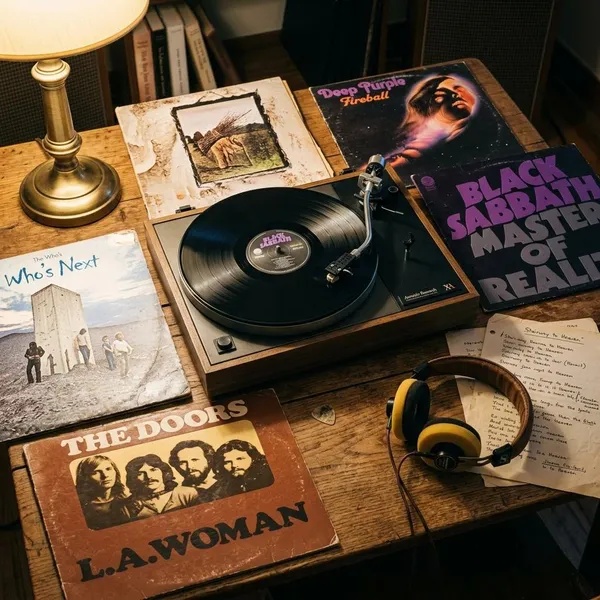
The easiest way to avoid turning 1971 into homework is to follow the sound you already like. A heavy-riff listener, a prog-curious listener, and someone who mostly cares about lyrics should not all start in the same place.
Hard rock — Led Zeppelin IV and Who's Next
For hard rock, pair Led Zeppelin IV with Who's Next. Zeppelin gives you texture, groove, folk shadows, and blues force; The Who give you polish, impact, and arena-sized release. Together, they show how broad hard rock already was by 1971.
Heavy metal — Master of Reality
Master of Reality is the clear heavy metal pick. It is slower, thicker, and more oppressive than most hard rock around it, and that is the point. If you mainly want speed or technical flash, it may feel blunt at first; if you want the roots of doom and riff-heavy metal, it is essential.
Progressive rock — The Yes Album and Meddle
The Yes Album and Meddle make a useful prog pairing because they take different routes. Yes are bright, busy, and tightly played; Pink Floyd are spacious, patient, and atmospheric, especially on "Echoes."
- The Yes Album: better if you want energy and musicianship upfront.
- Meddle: better if you prefer mood, slow build, and headphone listening.
Blues rock — Sticky Fingers and At Fillmore East
Sticky Fingers is the studio-side blues rock pick; At Fillmore East is the live-side pick. The Stones keep things stylish and song-shaped, while the Allman Brothers stretch the form until the playing becomes the main story.
Singer-songwriter rock — Tapestry and Imagine
Tapestry and Imagine are the best route if lyrics, melody, and voice matter more to you than riffs. Carole King is warmer and more open-hearted; Lennon is sharper and more restless. Both show how personal songwriting had moved into the center of rock-era album culture.
Glam rock — Hunky Dory and Electric Warrior
Hunky Dory and Electric Warrior are the glam-adjacent choices for listeners who like personality, style, and concise songs. Bowie is clever and theatrical; T. Rex is groovier and more immediate. Start with Electric Warrior for hooks, Hunky Dory for character.

Which 1971 classic rock album should you hear first?
For most people, the best first album is Led Zeppelin IV. The better question is what to play second, because that should depend on whether you want more power, more songwriting, more blues feel, or more experimentation.
Led Zeppelin IV for the best all-around introduction
Pick Led Zeppelin IV if you want one record that explains the appeal of 1971 without needing much background. It has famous songs, deep cuts, heavy moments, quiet contrast, and enough variety to point you toward several other paths afterward.
Who's Next for powerful, polished rock
Choose Who's Next when you want immediate payoff. It is the better first listen for someone making a driving playlist, testing the era through big hooks, or trying classic rock without wanting long jams or folk detours.
Sticky Fingers for blues and swagger
Sticky Fingers is the right first choice if you like groove, attitude, and songs that sound relaxed but dangerous. It is especially good for listeners who already enjoy blues, country-rock touches, or bands that sound best when they do not seem to be trying too hard.
The Yes Album for progressive rock
Start with The Yes Album if you are curious about prog but do not want the densest possible entry point. It has advanced playing, but it still moves with enough brightness and momentum to stay approachable.
Tapestry for personal songwriting
Tapestry is the best first listen for someone who values melody, emotional clarity, and songs that do not need volume to feel powerful. It is also the easiest recommendation for a quieter evening listen, while Master of Reality or At Fillmore East makes more sense when you want weight or performance energy.
- Start with your taste. Heavy guitar fans should begin with Zeppelin or Sabbath; lyric-first listeners should begin with King or Lennon.
- Add contrast next. Follow a hard rock album with Tapestry, or a singer-songwriter album with Sticky Fingers.
- Save the deep dive for third. Try At Fillmore East, Meddle, Ram, or Electric Warrior once the main shape of the year makes sense.
Why 1971 was a landmark year for rock
1971 stands out because several rock languages matured at once. Hard rock became bigger, metal became heavier, prog became more ambitious, singer-songwriters became central, and live albums started to feel like major artistic statements rather than extras.
Hard rock became heavier
Hard rock in 1971 was no longer just louder blues. Led Zeppelin IV used contrast and atmosphere, Who's Next used precision and scale, and Black Sabbath pushed the whole thing into darker, denser territory. That combination gave later bands a wider map to follow.
Progressive rock grew more ambitious
Progressive rock was becoming confident enough to treat the album as a full space rather than a container for singles. The Yes Album, Meddle, and, depending on release territory, Fragile show how different that ambition could sound: technical, spacious, melodic, or strange.
Blues rock reached a creative peak
Blues rock still had room to grow in 1971 because artists were using it differently. The Rolling Stones made it stylish and compact, Rod Stewart made it loose and rootsy, and the Allman Brothers made it expansive onstage. The shared source was old, but the results did not feel stuck in the past.
Singer-songwriters moved into the mainstream
Albums such as Tapestry, Imagine, and Joni Mitchell's Blue proved that personal writing could be as culturally important as heavy guitar records. That matters when listening through the year: 1971 is not only a story of volume, but also of emotional directness becoming mainstream.
Live albums became essential releases
At Fillmore East helped show that a live album could be definitive, not secondary. For bands built on improvisation, chemistry, and stage risk, the concert recording could capture something a studio album might smooth away.
Conclusion
The smartest way into 1971 is not to treat it like a ranked checklist. Start with one obvious classic, choose a second album that contrasts with it, and then follow the sound that catches your ear. If a single year can move naturally from Led Zeppelin IV to Tapestry, from Master of Reality to Electric Warrior, it deserves its reputation.