
The best way into classic rock guitarists is not to memorize a ranking, but to hear what each player changed: riffs, tone, solos, technique, or the whole feel of a song. If you are new to the music, start with Hendrix, Page, Clapton, Van Halen, and Gilmour, then branch out by the sound you enjoy most.
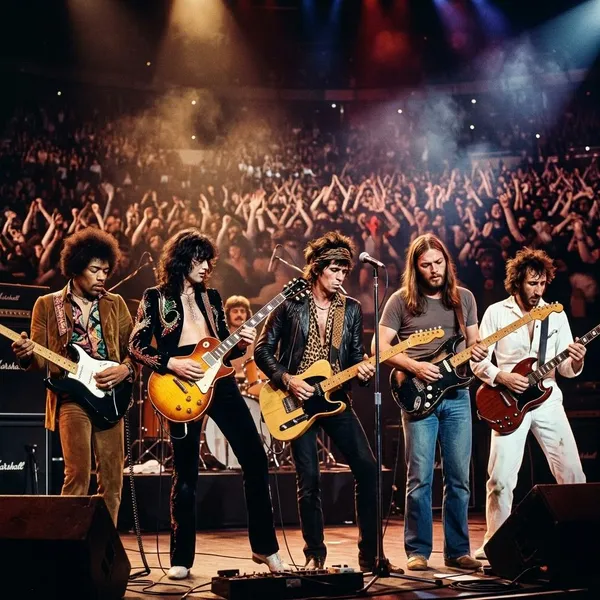
The greatest classic rock guitarists
Arguments about the greatest players never end because people listen for different things. A guitarist who writes unforgettable riffs is not doing the same job as one who builds slow, emotional solos or invents a new sound with gear and touch.
Jimi Hendrix
Jimi Hendrix is the most common starting point because he changed the vocabulary of electric guitar. Feedback, fuzz, wah-wah, chord fragments, rhythm playing, and lead lines all became part of one expressive voice rather than separate tricks.
If you only know the legend, listen for how controlled his wildest moments are. "Voodoo Child (Slight Return)" sounds explosive, but "Little Wing" shows the same imagination in a much more delicate setting.
Jimmy Page
Jimmy Page's greatness is easiest to hear in the way Led Zeppelin songs are built. The guitar is not just decoration; it often becomes the frame of the song, from the weight of "Whole Lotta Love" to the acoustic tension of "Ramble On."
Page is the right first choice if you want classic rock that feels physical and riff-driven, but he also rewards album listening because his arrangements shift between blues, folk, hard rock, and studio texture.
Eric Clapton
Eric Clapton matters because he helped bring electric blues phrasing into mainstream rock without losing its direct emotional pull. His best playing is not about speed first; it is about bends, vibrato, timing, and a singing tone.
Eddie Van Halen
Eddie Van Halen made technical guitar feel joyful instead of academic. Tapping is the famous headline, but his rhythm feel, harmonics, swing, and bright high-gain tone are just as important.
- For pure shock: play "Eruption."
- For song-first guitar: play "Ain't Talkin' 'Bout Love."
- For groove and flash together: play "Panama."
David Gilmour
David Gilmour proves that a slow bend can say more than a fast run. His Pink Floyd solos are built around space, sustain, tone, and emotional timing, especially on "Comfortably Numb," "Time," and "Shine On You Crazy Diamond."
What made these guitarists stand out
The important thing is not that every famous guitarist was "great" in a vague way. The lasting names usually owned at least one clear strength so completely that later players copied it, reacted against it, or used it as a starting point.
Memorable riffs
A memorable riff gives a song an identity before the singer even enters. Jimmy Page, Keith Richards, Tony Iommi, and Angus Young all show that a riff does not need many notes; it needs the right rhythm, attitude, and space around it.
Distinctive tone
Tone is where many players become recognizable within seconds. Brian May's layered, singing sound, Gilmour's wide sustain, Van Halen's sharp high-gain attack, and Billy Gibbons' thick blues-rock bite all work because the sound matches the musical personality.
Expressive solos
Expressive solos do not feel pasted onto a song. They answer the mood that is already there, then raise it. Gilmour leaves space, Clapton phrases like a blues singer, Hendrix bends sound into emotion, and Page often adds danger and momentum.
New techniques
New techniques only matter historically when they become musical language. Hendrix made feedback and effects feel expressive, Van Halen pushed tapping into mainstream rock, Duane Allman made slide a powerful lead voice, and Lindsey Buckingham brought unusual fingerpicking patterns into rock arrangements.
Lasting influence
Influence shows up when a player's ideas keep reappearing in other styles. Hendrix echoes through rock, funk, and alternative music; Page shaped hard rock riffing; Van Halen changed what young guitarists practiced; Gilmour influenced melodic and atmospheric lead playing.
Classic rock guitarists by playing style
Style is often more useful than rank. If you are building a weekend playlist, riff masters may be the easiest win. If you are learning guitar, blues-rock players and melodic soloists may teach you more about phrasing than speed alone.
Riff masters
Riff masters are the players whose parts can carry a whole song: Jimmy Page, Keith Richards, Tony Iommi, Angus Young, and Joe Perry are obvious examples. Start here if you want classic rock that hits quickly and does not require much background knowledge.
- Page: heavy, dramatic, arranged with scale.
- Richards: loose, grooving, instantly human.
- Iommi: darker and heavier, with a huge metal afterlife.
Blues-rock players
Blues-rock players keep the music close to bends, call-and-response phrasing, and vocal-like emotion. Eric Clapton, Stevie Ray Vaughan, Duane Allman, Jeff Beck, and Billy Gibbons all fit, though their touch is very different.
If you are a beginner guitarist, this category is especially useful because it teaches restraint. A few well-placed notes with the right bend can communicate more than a long run played without feel.
Lead guitar innovators
Lead guitar innovators changed what a solo could sound like. Hendrix made the electric guitar feel almost limitless, Van Halen made virtuosity exciting to mainstream listeners, Jeff Beck shaped notes with unusual touch, and Brian May turned harmonized leads into part of Queen's identity.
Tone pioneers
Tone pioneers are worth hearing on good speakers or headphones because the sound itself is part of the point. Gilmour's sustain, May's layered harmonies, Van Halen's attack, and Gibbons' thick blues tone all show how gear, hands, and taste combine.
Songwriter-guitarists
Songwriter-guitarists prove that the best guitar part is sometimes the one that makes the song unavoidable. Lindsey Buckingham, Pete Townshend, George Harrison, and Neil Young are not always discussed like pure lead heroes, but their parts are central to the records.
- Buckingham: tense, fingerpicked movement.
- Townshend: powerful chords and drama.
- Harrison: melodic economy.
- Young: raw repetition with emotional weight.
Slide guitar specialists
Slide guitar gives rock a voice-like quality because the notes can glide, ache, and swell. Duane Allman is the essential name here, especially for how he made slide a lead instrument in Southern rock rather than a background color.
Ry Cooder, George Harrison, and Billy Gibbons also show how slide can work in different settings, from rootsier textures to sharp blues-rock accents.
Essential songs for classic rock guitar
Songs are better than abstract praise because they show how a guitarist works inside a band. A solo clip can impress you, but a full track reveals timing, restraint, arrangement, tone, and whether the guitar actually serves the music.
| Song | Listen for | Best if you like |
|---|---|---|
| Jimi Hendrix — "Voodoo Child (Slight Return)" | Wah, rhythm-lead blend, controlled chaos | Innovation and raw energy |
| Led Zeppelin — "Whole Lotta Love" | A riff that dominates the whole track | Heavy hooks |
| Pink Floyd — "Comfortably Numb" | Melodic build and emotional pacing | Slow-burning solos |
| Van Halen — "Eruption" | Tapping, harmonics, speed, personality | Technical fireworks |
| Queen — "Brighton Rock" | Layered tone and delay-driven lead ideas | Guitar as arrangement |
Best classic rock guitarists for new listeners
The best starting point depends on what you want from the guitar. A casual listener making a short playlist should begin with the most recognizable songs. Someone trying to understand the instrument should spend more time with albums, because the quieter rhythm parts often explain the player better than the famous solos.
Jimi Hendrix for innovation
Choose Hendrix first if you want the electric guitar to sound unpredictable, colorful, and alive. Start with Are You Experienced? for immediate impact, then move to Electric Ladyland when you want the broader studio imagination.
Jimmy Page for riffs
Pick Jimmy Page if riffs are what make rock click for you. Led Zeppelin II gives you the heavy side quickly, while Led Zeppelin IV shows more range between force, folk influence, and dramatic arrangement.
- Start with: "Whole Lotta Love," "Black Dog," "Heartbreaker."
- Move next to: "Ramble On," "The Rain Song," "Ten Years Gone."
David Gilmour for melodic solos
David Gilmour is the safest recommendation for listeners who want beauty, atmosphere, and emotional pacing rather than constant flash. The Dark Side of the Moon, Wish You Were Here, and The Wall are the natural entry points.
Eddie Van Halen for technique
Go to Eddie Van Halen when you want guitar playing that feels athletic but still fun. The debut album Van Halen is the obvious first stop, and 1984 shows how his playing fit into bigger radio-ready songs.
Brian May for layered guitar sounds
Brian May is ideal if you like guitar that sounds arranged, theatrical, and almost orchestral. Start with A Night at the Opera, then try Sheer Heart Attack and News of the World to hear how his tone supports both hard rock and Queen's more dramatic side.
Conclusion
The smartest way to explore these players is to match the guitarist to the thing you actually enjoy: Hendrix for invention, Page for riffs, Clapton for blues phrasing, Van Halen for technique, Gilmour for feeling, and Brian May for layered sound. Start with a few essential songs, then let your own taste decide whether the next step is heavier riffs, deeper blues, atmospheric solos, or full albums.