
Most classic rock is built around 4/4, so true classic rock songs in 3/4 time are worth listening to carefully: they should feel like one-two-three, one-two-three, not like two big rolling beats. Good starting points include "Manic Depression," "Piano Man," "Norwegian Wood," "You've Got to Hide Your Love Away," "She's Leaving Home," "The Times They Are A-Changin'," and "Perfect Day." The quickest check is to find the strongest beat, then see whether the phrase resets after three steady pulses.

Essential classic rock songs in 3/4 time
These songs are useful because they show different faces of triple meter. Some are gentle and folk-like, some are dramatic, and one is proof that 3/4 does not have to sound polite. If you are building a playlist to train your ear, listen for the downbeat first, then notice whether the music rocks forward in three equal beats or rolls in two larger waves.
Manic Depression by Jimi Hendrix
"Manic Depression" is the track to play for anyone who thinks 3/4 automatically means "waltz." Hendrix and Mitch Mitchell make the meter feel tense, jagged, and physical. The bar still turns in three, but the performance has the bite and pressure of a rock trio pushing hard against the pulse.
For players, this is a good stress test. Count it slowly first, then listen again to how the drums fill the space without hiding the meter. The mistake is to hear the energy and assume it must be 4/4; the three-beat cycle is exactly what gives the song its unstable drive.
Piano Man by Billy Joel
"Piano Man" is one of the easiest popular examples to count because the one-two-three motion is right on the surface. The piano pattern, harmonica, and singalong phrasing all lean into the circular feel, which suits the barroom storytelling.
If you are new to hearing 3/4, start here before moving to more ambiguous songs. Tap only beat one for a verse, then count the two lighter beats between each tap. The pattern should feel natural almost immediately.
Norwegian Wood by The Beatles
"Norwegian Wood" uses 3/4 lightly rather than dramatically. The acoustic guitar and sitar give the song a floating quality, while the meter keeps the vocal line gently turning instead of locking into a square rock groove.
This is a good example for a casual listener who wants to hear triple meter without a heavy "dance" feel. Nothing about the track shouts its time signature; the clue is the way each phrase seems to lean, release, and begin again after three beats.
She's Leaving Home by The Beatles
In "She's Leaving Home," 3/4 helps the arrangement feel suspended and cinematic. The strings do not need a rock backbeat because the three-beat motion already gives the song shape. Each bar has a gentle lift, then a release, which fits the sadness of the story.
This is the better Beatles choice if you want to hear slow 3/4 as emotional sweep rather than acoustic folk rhythm. Compare it with "You've Got to Hide Your Love Away" and the difference is clear: same broad meter family, very different emotional result.
The Times They Are A-Changin' by Bob Dylan
"The Times They Are A-Changin'" keeps the arrangement plain, so the meter does more of the work. The three-beat motion carries the verses forward without turning the song into a march. That matters because the lyric is forceful, but the performance still feels rooted in folk tradition.
When listening, do not focus only on the guitar. Let the vocal phrasing show you where the bar resets. Dylan's delivery makes the pulse feel steady but not stiff, which is one reason the song still feels direct rather than dated.

How 3/4 changes the classic rock sound
The practical difference is feel. A 4/4 rock song often gives you a square, forward-driving frame; 3/4 turns the phrase sooner, so the music can sway, lean, or spiral. If you are listening for it, check the downbeat first, then ask whether the song feels like three steps in a circle or two bigger waves.
That distinction matters for different listeners. A songwriter may use 3/4 to make a simple chord progression feel less predictable. A guitarist or drummer has to phrase differently because fills, accents, and strums land in a shorter cycle. A casual listener may simply notice that the song feels older, more intimate, or more dramatic than a typical rock groove.
A strong first beat creates the waltz pulse
The clearest sign of 3/4 is a strong first beat followed by two lighter beats: strong-weak-weak. It may remind you of a waltz, but rock songs rarely present it in a formal dance style. The important part is that beat one keeps acting like the place where the bar lands.
Try this with "Piano Man" or "Norwegian Wood." Tap only the downbeat and let beats two and three pass. If the music keeps returning to that same point of arrival after three pulses, you are hearing the basic 3/4 shape.
Three-beat phrases break the usual rock groove
Rock ears are trained to expect four-beat balance. In 3/4, the phrase turns sooner, so even a simple melody can feel less squared off. That is why a song may seem familiar in harmony but unusual in movement.
Fast tempos make triple meter feel urgent
Fast 3/4 can feel almost breathless. Because the bar resets quickly, the music does not settle for long before the next downbeat arrives. "Manic Depression" uses that effect brilliantly: the meter spins, but the band attacks it hard enough that it feels edgy rather than graceful.
- Good fit: restless lyrics, sharp guitar accents, busy drums.
- Watch for: confusing speed with 4/4 drive.
- Listening check: slow the count in your head before judging the meter.
Slow tempos create a sweeping ballad feel
Slow 3/4 gives each measure room to open up. Piano, strings, and long vocal lines can stretch across the bar, which is why songs such as "Perfect Day" and "She's Leaving Home" feel broad without needing a heavy rhythm section.
This is the scenario where 3/4 can fool you in the opposite direction. Because the pulse is slow and smooth, you may stop counting and just hear "ballad." Go back to the strongest beat and follow the full measure; the three-beat shape is usually easier to hear once the vocal settles in.
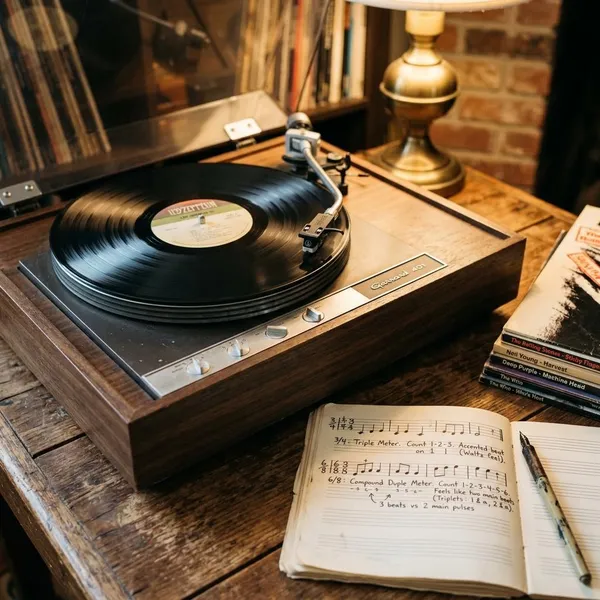
The difference between 3/4 and 6/8
This is the main reason lists of 3/4 rock songs get messy. Both 3/4 and 6/8 can feel lilting because both involve groups of three somewhere in the rhythm. The safer question is not "Do I hear threes?" but "How many main beats does the bar have?"
3/4 has three main beats
In 3/4, the bar has three primary quarter-note beats. You can count it as one-two-three, one-two-three, with the first beat usually carrying the strongest weight. "Piano Man" is a friendly example because the three main beats are easy to feel through the verse.
If your foot wants to mark three evenly spaced beats before the pattern starts again, 3/4 is the likely answer. This is the first thing to check before worrying about smaller subdivisions.
6/8 has two main beats
In 6/8, the bar contains six eighth notes, but the larger feel is usually two beats: ONE-two-three, FOUR-five-six. The small notes move in threes, but the body often feels two big rocks of motion rather than three equal steps.
- 3/4 feel: walk-walk-walk.
- 6/8 feel: sway-and-a, sway-and-a.
- Most useful clue: where the strongest accents naturally land.
3/4 follows a strong weak weak pattern
The strong-weak-weak pattern is the practical shortcut for 3/4. Beat one anchors the bar, while beats two and three feel lighter. Even when the arrangement is soft or busy, that downbeat tends to remain the center of gravity.
Listen for this in strumming patterns and bass movement. If the accompaniment keeps giving you one clear landing point followed by two lighter supports, you are probably not dealing with 6/8.
6/8 splits into two groups of three
6/8 is better understood as two grouped pulses rather than three main beats. That is why it often feels rolling, wave-like, or dramatic without having the neat turn of a waltz. Singers and rhythm sections usually phrase around those two larger accents.
"House of the Rising Sun" is the classic confusion point. It has triple subdivision on the surface, but many listeners feel the song in two broad pulses per bar, which is why 6/8 is usually the more useful reading. If you are making a clean 3/4 playlist, this is exactly the kind of song to separate from true triple-meter examples.
Conclusion
The best way to recognize 3/4 in classic rock is to stop chasing the surface rhythm and listen for the main beats: three steady pulses point toward 3/4, while two larger rolling pulses usually point toward 6/8. Start with obvious examples like "Piano Man," then compare them with Hendrix, Dylan, Reed, and the Beatles tracks to hear how flexible the meter can be. Once that downbeat pattern clicks, these songs stop feeling like odd exceptions and start sounding like deliberate choices.