
The easiest way to hear a great rock bridge is to notice the moment a familiar song suddenly stops circling and opens a new door. In classic rock songs with bridges, that change often adds tension, doubt, lift, or drama before the main hook comes back stronger. If you are making a playlist or trying to understand song structure, start by listening for a section that feels different and then asks, "Did the return hit harder because of that detour?"

Classic rock songs with unforgettable bridges
Some bridges are easy to spot because the whole mood changes. Others are short, almost sneaky, but they still shift the meaning of the song. The four songs here are useful because each one shows a different kind of bridge: emotional contrast, structural surprise, thematic movement, and dramatic escalation.
We Can Work It Out by The Beatles
"We Can Work It Out" is one of the cleanest examples of a bridge doing more than filling space. The main sections sound hopeful and persuasive, but the "Life is very short" middle section suddenly makes the argument feel more serious.
That short change matters because it adds pressure. The song is no longer just about two people trying to agree; it becomes a reminder that time is limited and stubbornness has a cost. For a casual listener, it is a memorable emotional turn. For someone studying songwriting, it is a compact lesson in how a bridge can deepen the whole lyric without dragging the song away from its hook.
A Day in the Life by The Beatles
"A Day in the Life" does not behave like a simple verse-chorus pop song, which is exactly why it is worth hearing closely. The shift into Paul McCartney's brighter, everyday section feels like stepping out of a dream and into a rushed morning routine.
The section works like a bridge because it changes perspective rather than repeating the main atmosphere. The opening has a distant, surreal quality; the contrasting middle is more grounded and rhythmic. If you are trying to identify bridges in more ambitious rock songs, this is a good warning: not every bridge arrives as a neat eight-bar block. Sometimes it is a major pivot that expands the world of the song.
Changes by David Bowie
"Changes" uses its bridge to make the theme feel active. The song is already about reinvention, but the contrasting section gives that idea a restless push, as if the music itself is trying to move out of its old shape.
The useful thing to listen for is not just "new section." Listen for how the bridge supports the title idea. A weaker song might simply repeat the word "changes" and trust the chorus to carry everything. Bowie's bridge helps the theme feel unsettled, theatrical, and human.
Somebody to Love by Queen
Queen's "Somebody to Love" shows that a bridge does not have to reduce the energy. It can raise the stakes. The song already feels large because of the layered vocals and gospel drive, but the bridge redirects that intensity so the later return feels even more urgent.
This is a useful track for playlist builders because the bridge is part of the drama, not a technical footnote. If you want songs where the middle section gives the final stretch more emotional weight, this belongs near the top of the list.
What makes a classic rock bridge work
A strong bridge creates contrast without sounding pasted in. The first thing to check is whether the song has already established a pattern, then whether the bridge changes that pattern in a way that makes the return feel better. A section can be strange, loud, quiet, or clever, but if it does not improve what follows, it may be more of a break than a truly effective bridge.
- Does it arrive after the song has settled into a pattern?
- Does something clearly change? Chords, melody, lyric, rhythm, or arrangement can all do it.
- Does the song return with more force, clarity, or emotion?
New chords create contrast
New chords are often the quickest signal that the bridge has arrived. Even without knowing the theory, you can hear the song leave its usual road for a moment. That detour may sound darker, brighter, more tense, or more open.
The mistake is assuming any unusual chord change must be a bridge. Check the job it does. If the new harmony pulls the listener away from the verse and chorus and then helps the main hook land harder, it is probably functioning as a bridge.
Fresh lyrics shift the meaning
A bridge is often where the lyric stops repeating the main message and reveals a sharper angle. It may add doubt to a confident song, urgency to a relaxed one, or vulnerability to a song that has been hiding behind attitude.
A new melody breaks repetition
A fresh melody can make the bridge obvious before you notice anything else. The vocal line might climb, stretch, tighten, or become more conversational. In radio-friendly classic rock, this kind of melodic turn gives the ear variety without making the song feel like a different track.
Rhythm changes reset the energy
Rhythm changes are especially powerful in rock because they affect the body before the brain labels the form. The drums may pull back, the groove may open up, or the phrasing may stop sitting in the same pocket.
For a drummer, guitarist, or active listener, this is often the best clue. A bridge can feel like a breath before a final push, or like a tightening of the spring before a solo or chorus breaks open.
The return gives the chorus more impact
The return is the real test. A bridge should make the chorus, hook, solo, or final section feel refreshed rather than merely repeated. If the song comes back and nothing feels changed, the bridge may be technically present but not especially effective.
Common bridge types in classic rock
Classic rock does not use one single bridge formula. Some songs use a tight vocal middle eight, while others turn the bridge into an instrumental passage or a larger multi-part movement. The useful question is not "What is this called?" but "What role is this section playing?"
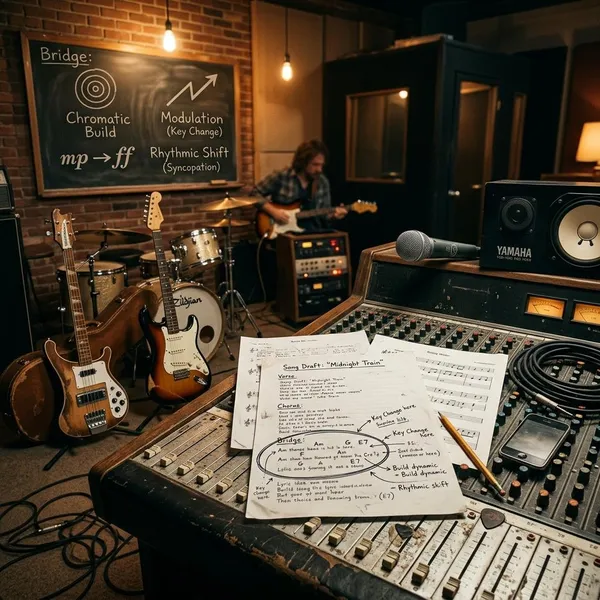
Vocal middle eights
A vocal middle eight is a short contrasting section with a new lyric and melody, often close to eight bars. In many Beatles-era pop and rock songs, this is the bridge in its most compact form.
This type is easiest for beginners to hear because the singer clearly moves away from the verse and chorus. The section usually appears once, says something fresh, and then hands the song back to familiar material.
Instrumental bridges
An instrumental passage can be a bridge if it creates contrast and moves the song toward a meaningful return. A guitar, keyboard, string part, or full-band change can all carry that role.
- Bridge: changes the song's direction and sets up the next section.
- Fill: adds decoration but does not reshape the structure.
- Solo section: may be a bridge, but only if it works as the main contrast.
Multi-part bridges
Multi-part bridges are common in more ambitious classic rock because the song may need more than one shift before it returns. One part might lower the energy, another might build tension, and another might push into a climax.
These bridges work when the parts feel connected by momentum. If each section feels like a random idea, the song can lose focus. If each part raises the stakes, the bridge becomes one of the most memorable parts of the recording.
Key-change bridges
A key-change bridge moves the tonal center so the song suddenly feels lifted, unsettled, or more exposed. Listeners do not need theory terms to notice it; the whole track feels as if it has shifted ground.
Used carefully, this can make the final return feel larger. Used too bluntly, it can sound like a trick. The better classic rock examples make the change feel emotionally necessary, not just impressive.
Bridges leading into solos
Rock songs often use a bridge to launch a solo. The bridge changes the mood or builds tension, then the guitar or another lead instrument takes over as the emotional voice of the track.
This is different from dropping a solo into the middle because "rock songs need solos." The stronger version gives the solo a reason to arrive. For guitar-focused listeners, that connection is often what separates a memorable instrumental break from a section that simply shows off.
How to identify a bridge while listening
The most reliable way to identify a bridge is to listen for a one-time section that appears after the song has taught you its main pattern. Do not start with technical labels. Start with contrast, timing, and return.

Wait for a late change in the song
Bridges usually need earlier material to contrast against, so they rarely appear before the song has established its main identity. A section that arrives after a second verse or second chorus and suddenly feels different is a strong candidate.
The boundary is important: an intro is not a bridge, and a first verse is not a bridge just because it is quieter. The bridge normally depends on the listener already knowing where "home" is.
Listen for new chords or melody
New chords or a new vocal shape often give the bridge away. The song may sound as if it has stepped into another room, even if the band is using the same instruments.
Notice a shift in lyrics or mood
Lyrics can reveal the bridge even when the arrangement stays fairly restrained. The singer may suddenly become more honest, doubtful, urgent, or reflective.
- Confidence turns into doubt.
- Storytelling turns into confession.
- Swagger turns into need.
- Calm turns into pressure.
Follow the return to the main hook
The section after the bridge often confirms what you just heard. If the chorus or main hook returns with more emotional force because the song stepped away, the bridge has done its job.
This is also the cleanest way to separate bridge and chorus. The chorus is the recurring center. The bridge is the contrast that makes that center feel alive again.
Conclusion
The best classic rock bridges are not just clever middle sections; they change how the rest of the song feels. Start by listening for a late contrast, then judge it by the return: if the hook, chorus, or solo lands with more weight afterward, the bridge is doing real work. Once your ear catches that pattern, familiar songs start to feel less like loops and more like small dramatic journeys.