
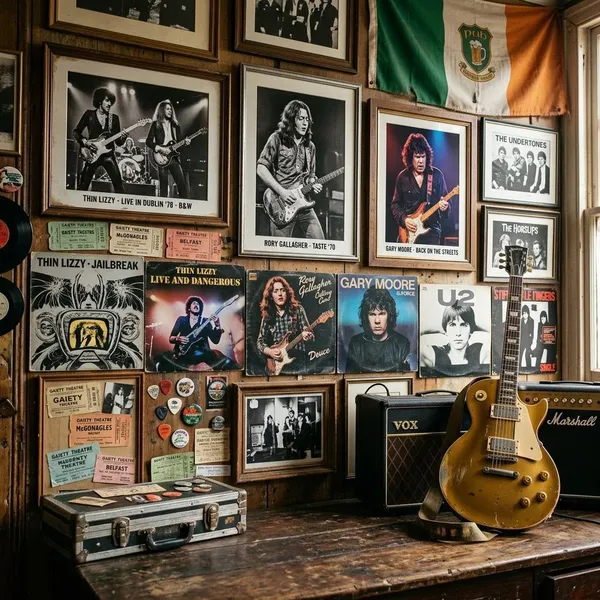
If you want to get into Irish classic rock bands without getting lost, start by choosing the sound you already enjoy: Thin Lizzy for riffs, U2 for big anthems, Rory Gallagher for guitar feel, Horslips for Celtic rock, or The Cranberries for 1990s atmosphere. Ireland's rock story is not one single style, so the best first move is not chronological perfection; it is finding the doorway that makes you want to keep listening.
Essential Irish classic rock bands and artists
The most useful way to approach Irish rock is by role. Some artists are essential because they shaped hard rock, some because they changed the scale of Irish music globally, and others because they opened doors into blues, punk, Celtic fusion, or alternative rock.
| If you usually like... | Start with | Why it works |
|---|---|---|
| 1970s hard rock | Thin Lizzy | Riffs, hooks, and twin-guitar harmonies |
| Big emotional rock | U2 | Atmosphere, scale, and unforgettable choruses |
| Guitar-led blues rock | Rory Gallagher | Live fire, feel, and improvisation |
| Folk roots with electric power | Horslips | Irish tradition inside a rock format |
| Fast, direct songs | Stiff Little Fingers or The Undertones | Punk urgency with two very different moods |
| 1990s alternative rock | The Cranberries | Mood, melody, and Dolores O'Riordan's voice |
How Irish classic rock developed
Irish classic rock did not develop in a neat straight line. Folk, blues, rhythm and blues, hard rock, punk, and alternative rock overlapped, with each period adding a new route rather than replacing the older one.
1960s blues and folk roots
The 1960s gave Irish rock its raw materials. Musicians absorbed American blues, rhythm and blues, British beat music, and local folk traditions, so storytelling and vocal character stayed important even as electric instruments became central.
Them, fronted by Van Morrison, are a key reference point from this period. They showed that Irish artists could work with rhythm and blues energy while still sounding emotionally distinct rather than like a copy of imported records.
1970s hard rock and Celtic rock
The 1970s are the decade classic rock fans should not skip. Thin Lizzy carried Irish hard rock onto the international stage, Rory Gallagher built a reputation through relentless performance, and Horslips gave Celtic rock a serious album-based identity.
If your main interest is classic rock in the older sense, this is probably the best historical entry point. It gives you riffs, guitar musicianship, and Irish tradition in three clearly different forms.
1980s punk and global success
The 1980s widened the map. U2 became one of the world's biggest rock bands, while Irish and Northern Irish punk acts proved that short, sharp songs could carry just as much force as long guitar statements.
1990s alternative crossover
The 1990s made Irish rock feel current to a new generation. The Cranberries reached listeners through alternative radio, MTV-era visibility, and songs that balanced intimate melody with a harder emotional edge when needed.
For a younger listener, starting in the 1990s is not cheating. It can be the most natural route: hear The Cranberries first, move to U2 for larger-scale atmosphere, then go back to Thin Lizzy or Rory Gallagher when you want heavier roots.
Essential Irish rock albums
Singles are useful for orientation, but albums show what each artist can sustain. The best first album is not always the "most important" one in a historical sense; it is the one that gives you enough of the artist's identity to decide whether to keep going.
Jailbreak by Thin Lizzy
Jailbreak is the cleanest Thin Lizzy starting point because it has the hits, the guitar identity, and the band's swagger in one place. The title track and "The Boys Are Back in Town" make the case quickly, but the album also shows how much character Phil Lynott could put into a hard rock record.
The Joshua Tree by U2
The Joshua Tree is the obvious U2 gateway because it captures the band at full emotional and commercial scale. "Where the Streets Have No Name," "With or Without You," and "I Still Haven't Found What I'm Looking For" show why U2 belong in the modern classic rock conversation even if they do not sound like a 1970s riff band.
It is especially useful for listeners who want atmosphere first and guitar weight second.
Irish Tour '74 by Rory Gallagher
Irish Tour '74 is the Rory Gallagher record to play when you want the point made fast. It puts him where his reputation is strongest: live, responsive, intense, and free enough for the songs to breathe.
Do not treat it as a bonus live document. For many listeners, it works better than a studio album as the first serious encounter with Gallagher.
Astral Weeks by Van Morrison
Astral Weeks is not a conventional rock record, and that is exactly why it matters. It blends folk, jazz, soul, and poetic vocal phrasing into something loose, immersive, and deeply individual.
If you want quick choruses, save it for later. If you want to hear how far Irish rock-adjacent songwriting can stretch, give it focused attention rather than half-listening in the background.
The Táin by Horslips
The Táin is the Horslips album that makes Celtic rock easiest to understand. Its mythological inspiration, folk elements, and electric arrangements work together instead of feeling like separate parts glued onto rock songs.
Inflammable Material by Stiff Little Fingers
Inflammable Material is direct, tense, and still startlingly alive. It is the right Stiff Little Fingers album if you want punk that feels tied to a real social environment without needing a long explanation before the songs hit.
The Undertones by The Undertones
The Undertones is one of the easiest punk albums to enjoy on first listen. The songs are short, tuneful, and full of nervous energy, with "Teenage Kicks" acting as the perfect front door rather than the whole story.
No Need to Argue by The Cranberries
No Need to Argue gives the fullest quick picture of The Cranberries because it holds their soft melodic side and the heavier force of "Zombie" on the same record. For listeners coming from alternative or indie music, it may be the most comfortable first album on the entire list.
How Irish classic rock styles differ
The easiest way to avoid overload is to stop asking which Irish rock band is "best" and ask which style you want tonight. A casual playlist listener may want Thin Lizzy, U2, or The Cranberries first; an album-focused listener may get more from Rory Gallagher, Van Morrison, or Horslips after a little patience.
Hard rock favors riffs and guitar harmonies
Hard rock is the best first lane if you want immediate punch. Thin Lizzy show how riffs, choruses, and twin-guitar harmonies can make songs feel powerful without turning them into pure heaviness.
Start here if you already like bands where guitar parts are memorable enough to sing back. Move elsewhere if you want looser improvisation or more atmospheric songwriting.
Blues rock favors feel and improvisation
Blues rock asks you to listen for touch rather than just hooks. Rory Gallagher's appeal is in the way a phrase bends, stretches, or catches fire in performance.
Celtic rock blends rock with Irish tradition
Celtic rock is not simply rock music with an Irish label. At its best, as with Horslips, traditional themes and musical ideas affect the structure, mood, and identity of the songs.
This is the lane to choose if you want the strongest connection between rock and Irish cultural material. It may be less instantly familiar than U2 or The Cranberries, but it gives the wider story more depth.
Punk favors speed and directness
Punk cuts away decoration. Stiff Little Fingers use that directness for confrontation and pressure; The Undertones use it for speed, hooks, and teenage restlessness.
- Choose Stiff Little Fingers when you want sharper political and social bite.
- Choose The Undertones when you want punk energy with more pop melody.
Alternative rock favors mood and texture
Alternative rock shifts the focus toward atmosphere, vocal identity, and emotional contrast. The Cranberries are the clearest Irish example here, while U2 overlap with the style through spacious guitar textures and widescreen arrangements.
Conclusion
The best way into Irish rock is to follow your ear first and the history second. Start with the sound that already fits you, then deliberately jump to a contrasting artist so the range becomes clear: riffs to atmosphere, blues feel to punk speed, Celtic fusion to alternative texture. That approach makes Irish classic rock bands feel less like a homework list and more like a set of connected paths worth exploring.