
If you want to hear rock inspired by classical music clearly, start with songs where the classical link changes the whole feel of the track, not just the arrangement. Some are direct reworkings of Bach, Mussorgsky, or Beethoven; others use classical-style movement, harmony, or structure while staying fully original rock songs.
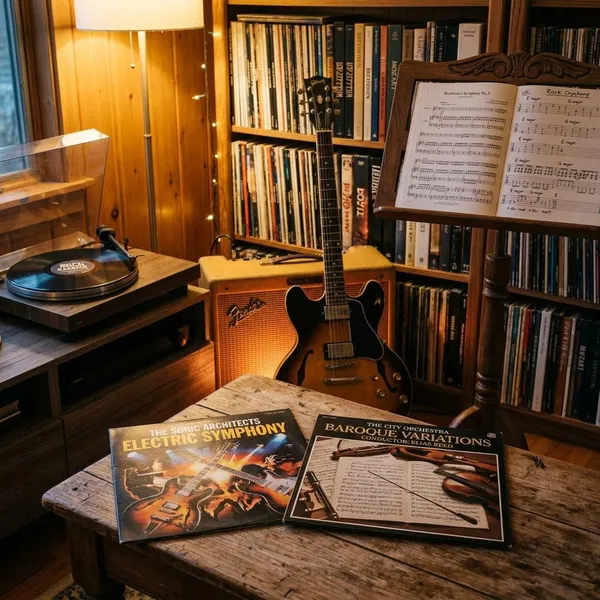
Essential rock songs based on classical music
The quickest way into this crossover is to separate two listening situations. If you are new to the topic, begin with direct adaptations because the source is easy to hear. If you already know the famous examples, listen for subtler signs: baroque keyboard motion, independent guitar lines, recurring themes, or a song shape that feels closer to a suite than a standard verse-chorus track.
- Start with the melody: is the main theme borrowed, adapted, or only classical in style?
- Notice the arrangement: drums, guitar, organ, and distortion can turn formal material into something urgent.
- Check the structure: long sections, reprises, and dramatic shifts usually point to deeper classical influence.
Procol Harum – A Whiter Shade of Pale
"A Whiter Shade of Pale" is not a straight Bach cover, but the organ part makes the classical connection hard to miss. Its baroque-like movement, solemn tone, and churchy atmosphere give the song a weight that feels unusual for a 1960s hit.
The useful distinction is that Procol Harum borrowed a language rather than simply lifting a famous tune. That makes it a strong example for listeners who want to understand how classical influence can shape mood and harmony without turning the song into an adaptation.
Jethro Tull – Bourée
Jethro Tull's "Bourée" is one of the cleanest entry points because it is built from J.S. Bach's Bourrée in E minor. The melody remains recognizable, but the flute phrasing, bass feel, and relaxed groove make it sound like a living rock performance rather than a careful museum piece.
Rainbow – Difficult to Cure
"Difficult to Cure" makes Beethoven's "Ode to Joy" feel like hard rock spectacle. The theme is instantly familiar, but the punch comes from the band's heavier attack, bright tempo, and sense of showmanship.
This is also a useful bridge into neoclassical metal. If the ELP example shows classical form inside prog, Rainbow shows how classical melody and heroic drama could feed guitar-driven hard rock.
How classical music shapes rock
When a rock song sounds "classical," ask what is actually being borrowed. It might be a full piece, a short melodic idea, a harmonic habit, a formal plan, or simply the way the arrangement builds tension. That first check prevents everything from being placed under one vague label.
Direct adaptations of classical works
Direct adaptations are the easiest to identify because the classical source is part of the song's main identity. "Bourée," "Difficult to Cure," and ELP's Pictures at an Exhibition all ask the listener to recognize older material in a new setting.
Borrowed melodies and chord patterns
Some songs borrow a contour, bass motion, or harmonic pattern rather than a complete composition. That can make the music feel faintly familiar without becoming a cover.
- Melody: a phrase resembles a classical theme but is reshaped.
- Harmony: the chord movement creates a formal or dramatic pull.
- Bass motion: the low line gives the song a baroque or stately feel.
Classical forms and multi-part songs
Classical form matters most in longer rock pieces. Instead of repeating verse and chorus, a band may use episodes, returns, instrumental passages, and recurring themes. Progressive rock leaned heavily on this approach because it let songs move like miniature journeys.
Counterpoint and complex harmony
Counterpoint means separate musical lines working together rather than one melody sitting on top of plain chords. In rock, that might be a bass line that behaves melodically, a guitar answering a keyboard phrase, or vocal parts that move independently.
Orchestral sound and dynamics
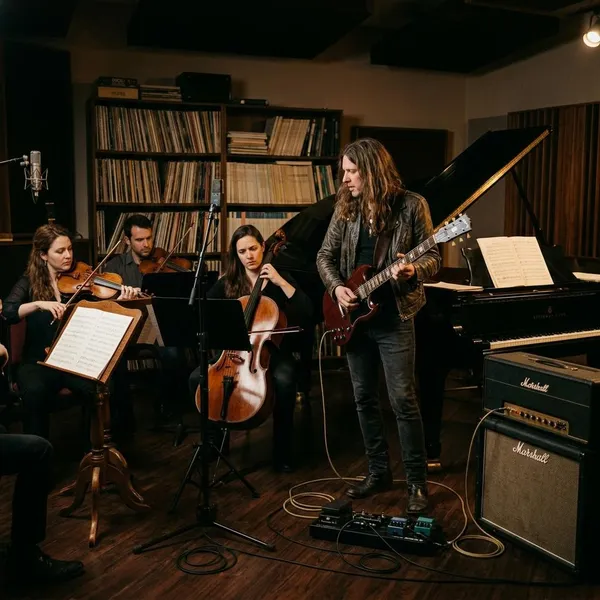
Orchestral sound is about color and scale: organ, Mellotron, piano, strings, layered guitars, and wide crescendos can make a rock band feel larger than its lineup. Dynamics are just as important. A sudden drop into quiet tension can make the next full-band entrance hit much harder.
Why classical music works so well in rock
Classical music and rock meet naturally because both can be dramatic, physical, and built around memorable themes. Rock adds force and immediacy; classical thinking adds shape, contrast, and longer emotional build. The blend works best when those strengths serve the song rather than just showing off cleverness.
Strong drama and emotional build
Classical writing often depends on tension and release, and rock thrives on the same instinct. A quiet opening, a rising figure, and a powerful arrival can make even a short song feel more theatrical.
This is why the crossover works for both casual and serious listening. A casual listener feels the emotional lift immediately; a deeper listener can return to the track and hear how the build was constructed.
Technical skill and showmanship
Classical influence gives rock musicians a natural stage for precision, speed, and control. Keyboard players can turn baroque-style runs into drama, while guitarists can use violin-like phrasing, fast sequences, and sharp articulation.
The warning is that technique alone gets tiring quickly. The strongest examples attach skill to a memorable theme, so the performance feels exciting rather than like an exercise.
Recurring themes and long structures
A recurring theme helps a long rock piece stay coherent. When a melody returns after a contrasting section, the listener gets a sense of recognition and payoff.
Sharp changes in volume and mood
Quiet-to-loud movement is one of the easiest classical habits for rock bands to use well. A restrained verse can make a heavy chorus feel bigger, and a sudden shift into darkness or brightness can reset the listener's attention.
For modern listeners, this may be the most familiar classical technique because it appears far beyond prog: alternative rock, post-rock, metal, and piano-led rock all use dramatic contrast to keep a song from feeling flat.
Rock styles with the strongest classical influence
The strongest classical influence appears in styles that value structure, atmosphere, or technical performance. If you want obvious classical references, start with progressive rock, symphonic rock, and neoclassical metal. If you prefer shorter songs, art rock, baroque pop, and some modern alternative rock may be easier to enjoy first.
Progressive rock
Progressive rock is the main home for long-form classical thinking in rock. Bands such as Yes, Genesis, Emerson, Lake & Palmer, The Nice, and Rush expanded song length, used recurring themes, and treated albums as connected works rather than collections of singles.
Choose prog when you want structure and development. It is less ideal if you only want a quick hook, but it rewards patient listening because the best pieces change shape as they unfold.
Symphonic rock
Symphonic rock overlaps with progressive rock, but it leans more toward grandeur and atmosphere. Mellotron, organ, layered keyboards, strings, and broad crescendos are common tools.
This style is often easier to enter than the most complex prog. The appeal is immediate: bigger sound, wider emotional space, and arrangements that feel cinematic even when the song itself is not technically difficult.
Art rock and baroque pop
Art rock and baroque pop bring classical influence into compact songwriting. Procol Harum, The Beatles, and The Left Banke used refined harmony, string color, and baroque-style textures without always stretching songs into long suites.
This is a good route for listeners who like classic pop hooks but want more unusual arrangement choices. The songs usually stay concise, so the classical flavor adds character rather than taking over the whole format.
Neoclassical metal
Neoclassical metal turns classical speed, sequence, and dramatic minor-key language into guitar-centered intensity. The style often points toward Bach, Vivaldi, Paganini, and violin repertoire, though the result is built for electric guitar and heavy rhythm sections.
- Best for: listeners who enjoy virtuoso solos and fast instrumental passages.
- Less ideal for: anyone looking for subtle classical influence or song-first restraint.
- Key check: the best tracks still need a memorable theme, not just speed.
Modern alternative rock
Modern alternative rock usually uses classical influence less openly. Radiohead and Muse, for example, often work with piano color, romantic tension, unusual harmony, and carefully staged dynamics rather than direct quotation.
This path matters because it keeps the crossover from feeling locked in the 1970s. A modern band can use classical technique while still sounding current in production, mood, and songwriting identity.
Key artists in the classical-rock crossover
The main artists in this crossover are useful because they show different ways to use classical ideas. Some made famous adaptations, some changed rock arrangement from the inside, and some turned classical technique into a performance style. If you are building a listening path, move from the most obvious examples to the subtler ones instead of treating all of them as the same kind of "classical rock."
Procol Harum and The Beatles
Procol Harum and The Beatles helped bring classical color into mainstream rock without making the songs feel academic. "A Whiter Shade of Pale" used baroque atmosphere as a central hook, while The Beatles folded strings, counterpoint, and classically informed guitar ideas into studio songwriting.
Their shared lesson is reach. They showed that richer harmony and arrangement could work in songs people still remembered after one listen.
Jethro Tull and Emerson, Lake & Palmer
Jethro Tull and Emerson, Lake & Palmer represent two very different attitudes toward older material. Jethro Tull made Bach feel nimble and playful; ELP made classical reworking large, theatrical, and technically bold.
Yes and Genesis
Yes and Genesis are essential because they often sound classically influenced without relying on famous borrowed tunes. Their long compositions, layered arrangements, and thematic returns show classical thinking at the level of architecture.
That makes them especially helpful for understanding the difference between quotation and influence. The music may not point to one composer, but it often behaves with the patience and shape of larger composed forms.
Rainbow and Yngwie Malmsteen
Rainbow helped connect hard rock with classical drama, while Yngwie Malmsteen made neoclassical guitar language a defining feature. Together they mark the path from classical-flavored hard rock to a more explicit metal style built around speed, sequence, and precision.
Conclusion
The best starting point is to hear the difference between direct adaptation and deeper influence: Jethro Tull, ELP, and Rainbow make the source obvious, while Procol Harum, The Beatles, Yes, Genesis, Radiohead, and Muse show how classical ideas can shape mood, movement, and structure. Once that distinction clicks, rock inspired by classical music becomes much easier to explore without reducing every song to a borrowed melody.