
Mötley Crüe became classic rock in public perception around the early 2000s, not on one official date. The band's original identity was glam metal and hard rock, but once their 1980s hits aged into radio staples and nostalgia culture, the classic rock label started to make sense. The easiest way to judge it is to separate what they were when they arrived from how listeners usually encounter them now.
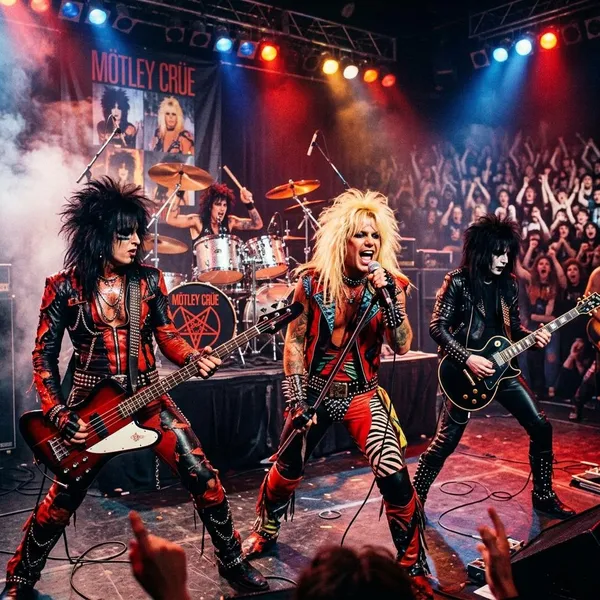
Mötley Crüe originally belonged to glam metal
Mötley Crüe did not start as a classic rock band. They came out of a very specific early 1980s Los Angeles scene where loud guitars, theatrical image, club buzz, and MTV-ready attitude all mattered. If you are trying to classify their roots, glam metal is the first label to check.
The band emerged from the Sunset Strip scene
Mötley Crüe formed in Los Angeles in 1981, right as the Sunset Strip was becoming a proving ground for hard rock bands with big personalities and bigger stage shows. Clubs such as the Whisky a Go Go helped create a scene where a band needed more than good songs; it needed a look, a reputation, and a sense that something could go wrong at any minute.
That matters for the classic rock question because the band first belonged to a living, current scene. They were not being presented as timeless heritage rock in the 1980s. They were part of the new wave of loud, flashy, dangerous-looking rock bands trying to define the decade.
Heavy riffs connected them to metal and hard rock
The makeup and hair can make people underestimate how heavy early Mötley Crüe could be. Songs such as "Live Wire" and "Shout at the Devil" had darker riffs, aggressive drums, and enough menace to keep them connected to metal as well as mainstream hard rock.
- For genre history: their early sound fits glam metal and heavy metal more than classic rock.
- For radio today: the same riffs are old enough and familiar enough to sit inside a classic rock playlist.
Glam fashion shaped their public image
The band's visual style was never a side detail. Leather, makeup, teased hair, boots, and theatrical posing helped make Mötley Crüe instantly recognizable, and that image tied them tightly to glam metal in the public imagination.
MTV helped turn them into an 1980s rock phenomenon
MTV made Mötley Crüe easier to remember as a full cultural package, not just a band with guitar tracks on the radio. Videos for songs such as "Looks That Kill," "Home Sweet Home," and "Girls, Girls, Girls" gave casual listeners a visual shortcut to the band's whole world.
A listener who saw them on MTV in 1985 experienced them as modern rock spectacle. A younger listener finding those same videos decades later is more likely to see them as a snapshot of 1980s rock history. That change in viewpoint is exactly how a current act gradually becomes a classic act.

How the classic rock label expanded
Classic rock is not a fixed genre in the same way that glam metal or thrash metal is. It has always been shaped by radio formats, audience age, and which songs keep testing as familiar. That is why the label can expand without the music itself changing.
Early classic rock radio focused on older decades
Early classic rock radio leaned heavily on late 1960s and 1970s artists: Led Zeppelin, The Who, Aerosmith, Pink Floyd, The Rolling Stones, and similar bands. In that version of the format, Mötley Crüe simply arrived too late. During their rise, they were a current 1980s band, not an older catalog act.
1980s hard rock gradually entered the format
By the late 1990s and especially the early 2000s, stations had a practical reason to widen the format. People who grew up on 1980s hard rock were now older listeners with deep attachment to those songs, so programmers began placing bands like Def Leppard, Bon Jovi, Guns N' Roses, and Mötley Crüe next to older arena rock staples.
That did not mean Mötley Crüe suddenly sounded like a 1970s band. It meant songs such as "Kickstart My Heart" and "Dr. Feelgood" had become familiar enough to serve the same function: proven, energetic rock tracks that listeners recognized immediately.
Aging audiences changed what counted as classic
A song often becomes "classic" when the people who heard it as new start hearing it as part of their past. For someone who was a teenager in 1987, Mötley Crüe was current rock. For that same person driving to work in 2005, those songs could already feel like music from another life stage.
Familiar hits became heritage rock staples
Mötley Crüe had the kind of songs that could survive beyond their original chart moment. "Home Sweet Home," "Girls, Girls, Girls," "Kickstart My Heart," and "Dr. Feelgood" kept showing up on radio, in sports settings, in films, and on playlists.
Once a song keeps appearing long after its release, it stops belonging only to its release year. It becomes shorthand for an era. That is why a casual listener today may call Mötley Crüe classic rock even if a genre-focused fan would still start with glam metal.

The transition from current band to classic act
The most useful timeline is simple: the 1980s created the catalog, the 1990s made that catalog feel older, and the early 2000s made the classic rock framing feel normal. If you need one clean answer, choose the early 2000s, but understand it as a gradual shift rather than a switch being flipped.
The 1980s as their original hit-making era
The 1980s were Mötley Crüe's main hit-making period. Too Fast for Love introduced the attitude, Shout at the Devil sharpened the heavier identity, and albums such as Theatre of Pain, Girls, Girls, Girls, and Dr. Feelgood turned them into major rock stars.
During that run, calling them classic rock would have sounded wrong. They were the present tense: MTV, arena tours, headlines, excess, and new records. The only reason they could become classic later is that this period produced enough memorable material to last.
The 1990s as the beginning of catalog nostalgia
The 1990s pushed many 1980s hard rock bands into a different position. Grunge and alternative rock changed the center of mainstream rock, so older Mötley Crüe songs began to carry more weight than their place in the current trend cycle.
The early 2000s as the clearest turning point
The early 2000s are the best practical answer because enough time had passed for the band's peak era to feel historical. Their biggest songs were no longer recent hits, classic rock radio was making more room for 1980s hard rock, and broader pop culture had started treating the 1980s as something to revisit.
That is also why the shift can feel blurry. A radio programmer, a longtime fan, and a younger listener may not have used the label at exactly the same moment. But by the early 2000s, calling Mötley Crüe classic rock no longer felt especially strange.
Later tours and media strengthened their legacy status
Reunion tours, farewell tours, comeback announcements, memoir-driven storytelling, and The Dirt all pushed Mötley Crüe further into legacy territory. These projects sold the band as a piece of rock history as much as an active musical act.
The Bowling for Soup song "1985" is a useful cultural clue, not an official genre decision. It captured the idea that 1980s rock had become nostalgia for a large audience. Mötley Crüe was already part of that memory bank; the song simply reflected the mood.
How to classify Mötley Crüe today
The cleanest answer depends on what you are trying to describe. If you are talking about where the band came from, say glam metal. If you are talking about how their famous songs are used on radio and in popular memory now, classic rock is fair.
| Question you are answering | Best label to use |
|---|---|
| Their original scene and image | Glam metal |
| The broad sound of many songs | Hard rock |
| The heavier edge of early material | Heavy metal |
| Their current radio and legacy position | Classic rock |
Conclusion
Mötley Crüe became classic rock gradually, with the early 2000s standing out as the clearest turning point. The practical answer is not to replace one label with another: call them glam metal when discussing their origins, hard rock or heavy metal when focusing on sound, and classic rock when talking about how their catalog lives now. That gives a more accurate picture than trying to force the band into one permanent box.